
What to Do After a Manic Episode: A Family Recovery Guide
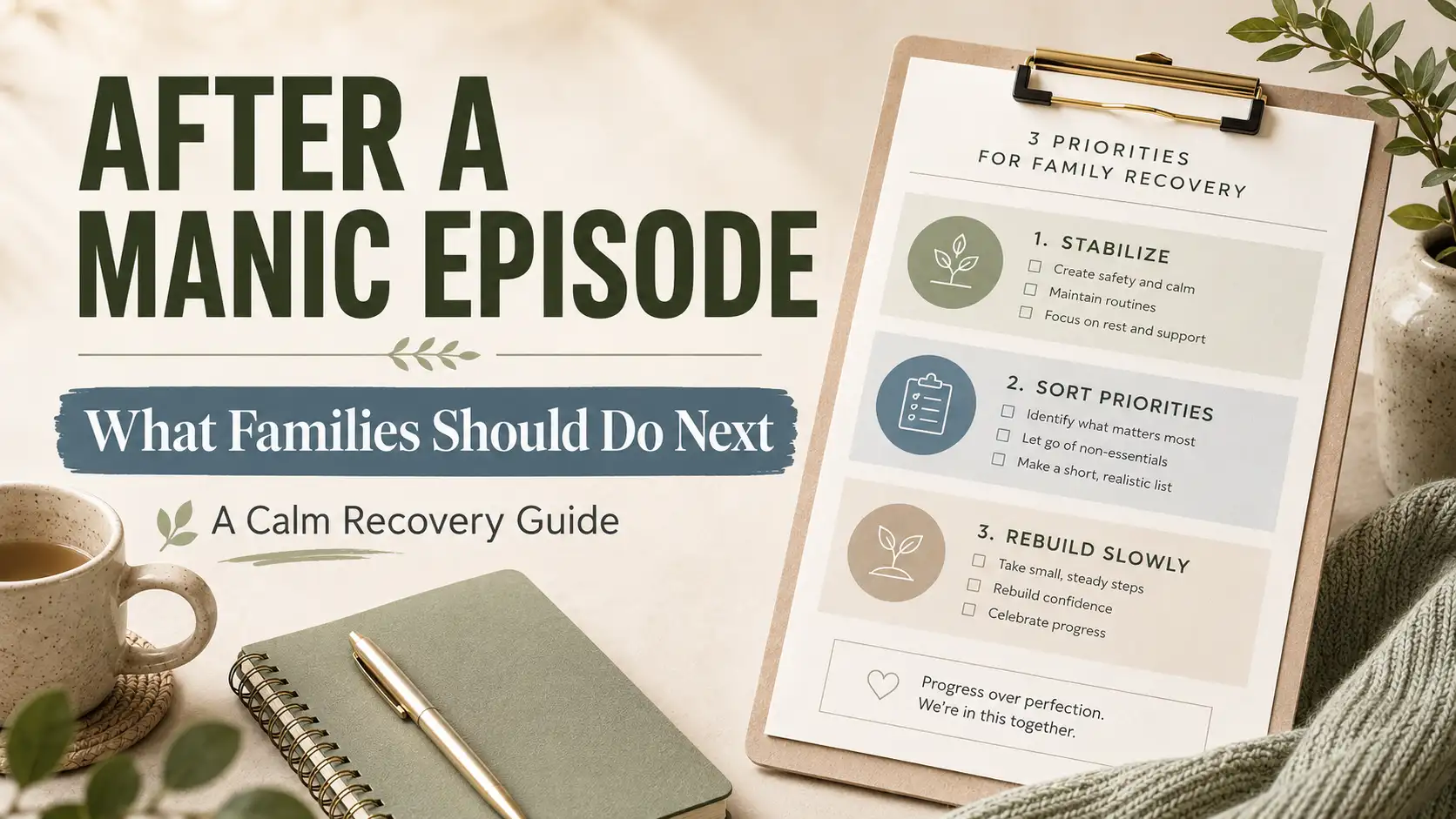
When a manic episode appears to be settling, families often feel a mix of relief and uncertainty. The most intense period may be quieter, but that does not mean everyone immediately feels back to normal. There may still be exhaustion, practical consequences, unfinished conversations, and emotions that have not yet caught up with what happened.
This guide focuses on what families and caregivers can do during that aftermath. It is not a guide to deciding whether mania has medically ended, treating bipolar disorder, or changing someone’s care. If your loved one still appears to be in an active manic episode, the guidance in how to help someone during a manic episode may be a better place to start.
This article is for general education and is not a substitute for professional medical, psychiatric, legal, financial, or emergency advice.
Quick Answer: What Should Families Do After a Manic Episode?
After a manic episode appears to be settling, focus first on reducing pressure, addressing immediate safety concerns, and allowing a gradual return to everyday routines. Encourage your loved one to stay connected with their existing healthcare team rather than trying to make clinical decisions as a family. You do not have to resolve every argument or consequence immediately. Sort practical problems by urgency, leave non-urgent conversations for a more manageable time, and keep healthy boundaries in place. If symptoms remain concerning, return, or develop into a mental health crisis, seek appropriate professional or crisis support rather than trying to manage the situation alone.
What Can Happen After a Manic Episode?
There is no universal pattern for manic episode recovery. What happens next can vary considerably from one person to another, and families should be careful not to assume that every change in mood, energy, or behavior has the same meaning.
Physical and mental exhaustion
Some people may feel physically or mentally exhausted after an intense period of mania. Disrupted sleep, sustained activity, and the demands of the episode may leave the person needing more rest and a slower return to everyday responsibilities.
The family may be exhausted too. It is possible for the emotional impact of an episode to become more noticeable only after the most intense period has passed.
Low mood or depression may follow
Some people experience significant low mood or a depressive episode after mania, but this does not happen to everyone. A quieter mood after an intense episode also does not allow family members to determine on their own that someone is experiencing bipolar depression.
Changes that are persistent, worsening, or concerning are better discussed with the person’s healthcare team rather than interpreted at home.
Regret, embarrassment, or shame
As the situation becomes calmer, some people may feel regret, embarrassment, guilt, or shame about things that happened during the episode. Others may not be ready to discuss what happened, or may remember events differently from the people around them.
Families do not need to force an immediate emotional reckoning. There can be time later to address what happened while still recognizing that important consequences and boundaries may eventually need attention.
Feeling overwhelmed by commitments or consequences
An episode may leave behind messages to answer, commitments to reconsider, financial concerns, work issues, damaged relationships, or other practical problems. Seeing all of these at once can feel overwhelming for everyone involved.
It often helps to stop thinking of the aftermath as one enormous problem and start sorting it into smaller questions: What genuinely needs attention now? What should be handled soon? And what can safely wait?
What Should Families Do in the First Few Days?
The first priority is not necessarily to resolve every consequence of the episode. A calmer approach is to focus on immediate needs while avoiding unnecessary pressure.
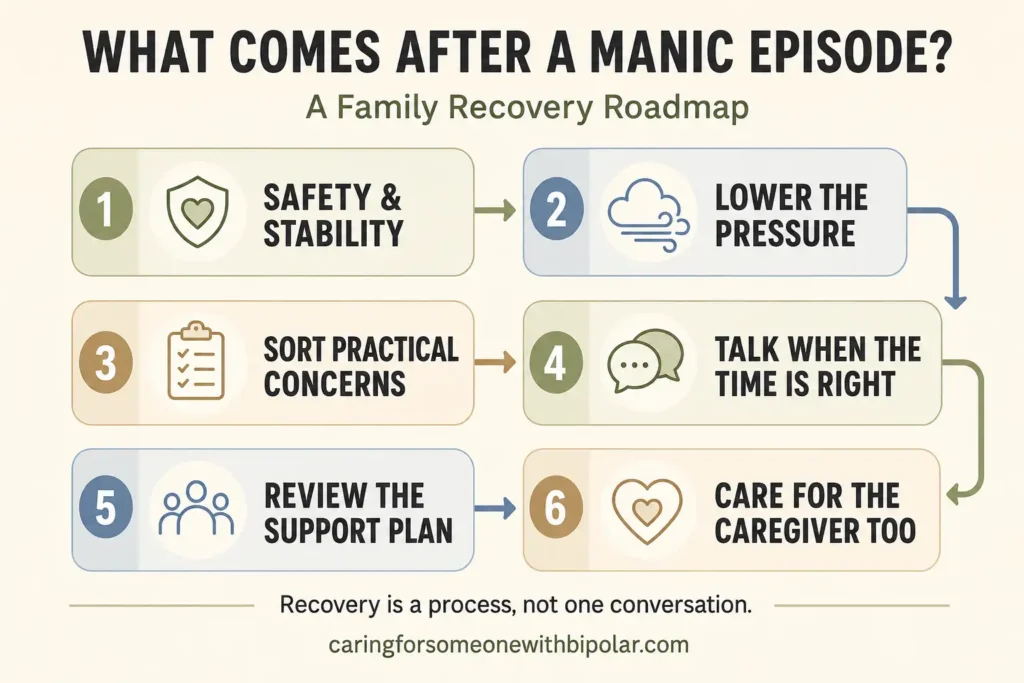
Stability comes before trying to resolve everything.
Lower the pressure
After an acute mental health episode, pushing immediately for explanations, apologies, major decisions, or a full return to normal responsibilities can add more pressure to an already difficult situation.
When circumstances allow, give the person room to rest and ease back into ordinary activities rather than expecting everything to return to its previous pace at once.
Support basic routines without taking over
Families can support a gradual return to familiar routines without trying to direct every choice. Offering practical help is different from assuming control over another adult’s life.
You might ask, “Is there anything practical that would make today easier?” rather than deciding automatically what the person needs.
How much support is appropriate will depend on the situation, the person’s preferences, any existing care plan, and whether there are genuine safety concerns.
Encourage connection with the existing care team
Family members do not have to determine whether every change is part of recovery, a new mood episode, a medication issue, or something else. Encourage your loved one to stay connected with the healthcare professionals already involved in their care.
The family’s role is support, not diagnosis or treatment management.
Postpone non-urgent arguments and major decisions
Some problems require prompt attention, but many do not need to be solved immediately. A major relationship discussion or non-urgent family dispute may be easier to approach when both people have more capacity for the conversation.
Postponing a conversation is not the same as pretending the problem does not exist. It can simply mean choosing a more workable time to address it.
How Do You Know When More Support Is Needed?
A difficult recovery period is not automatically a mental health crisis. At the same time, families should not feel responsible for managing serious or worsening concerns alone.
The following table is an organizational guide, not a diagnostic tool.
| Situation | What You May Notice | General Next Step |
|---|---|---|
| Gradually settling | Fatigue or emotional sensitivity that appears to be easing over time | Offer support, allow a gradual return to routine, and stay connected |
| Concerning symptoms persist or return | Marked sleep changes, agitation, unusual mood changes, or other symptoms that remain concerning | Encourage contact with the person’s healthcare team for guidance |
| Mental health crisis | Severe emotional distress, talk of suicide or self-harm, or concern that the person may not be able to stay safe | Seek prompt crisis support. In the United States, call or text 988 for crisis support |
| Immediate danger | An immediate risk of serious harm or another life-threatening emergency | Prioritize immediate safety and contact emergency services |
In the United States, family members and caregivers can also contact the 988 Suicide & Crisis Lifeline when they are concerned about someone else. If there is immediate danger or a life-threatening emergency, call 911.
How Should You Talk About What Happened?
Families often feel a strong need to understand the episode, address hurtful events, or determine what happens next. Those conversations may be necessary, but they do not all have to happen at once.
Do not force the entire conversation immediately
A full review of everything that happened may be too much for one conversation, especially when the person and the family are still exhausted. Start with the most important issue rather than trying to reconstruct the entire episode in one sitting.
Ask whether it is a manageable time to talk
A simple check-in can create a more respectful starting point:
- “There are a few things we will eventually need to talk about. Is now a manageable time for one of them?”
- “You do not have to explain everything today. We can handle one thing at a time.”
- “I care about you, and there are also things that affected the family that we will need to address when we are both able to talk about them.”
If the person still appears actively manic, communication may require a different approach. See what to say during a manic episode for guidance focused specifically on that stage.
Describe impact without attacking character
Focus on a specific event and its effect rather than making a global judgment about the person.
For example, “I was frightened when I could not reach you and did not know where you were” is more specific than “You never care what you put this family through.”
Specific language leaves more room for an actual conversation.
Address one problem at a time
If there are financial concerns, family conflicts, damaged trust, and practical commitments to resolve, choose a starting point. Trying to discuss every consequence at once can make the conversation harder to manage.
Separate accountability from humiliation
Accountability can include acknowledging an impact, repairing what can reasonably be repaired, and respecting boundaries going forward. Humiliation attacks the person’s worth or uses shame as punishment.
The family does not have to choose between compassion and accountability.
How Can You Respond to Shame, Regret, or Embarrassment?
Compassion does not require pretending nothing happened. Accountability does not require humiliation.
If your loved one expresses regret or shame, you can acknowledge that emotion without immediately minimizing the consequences.
You might say:
“I know this is difficult to look back on. We do not have to solve everything today, but there are a few things we will need to work through.”
This leaves room for both realities: the person may be hurting, and the family may also have legitimate concerns.
Avoid using embarrassment as a tool to prevent another episode. Shame is not a treatment plan, and family members cannot guarantee that another episode will never occur. The more useful goal is to address practical consequences, maintain appropriate boundaries, and learn what may be helpful to review with the person’s care team or support plan.
What Practical Problems Should the Family Handle First?
When many problems are competing for attention, sorting them by urgency can make the aftermath feel more manageable.
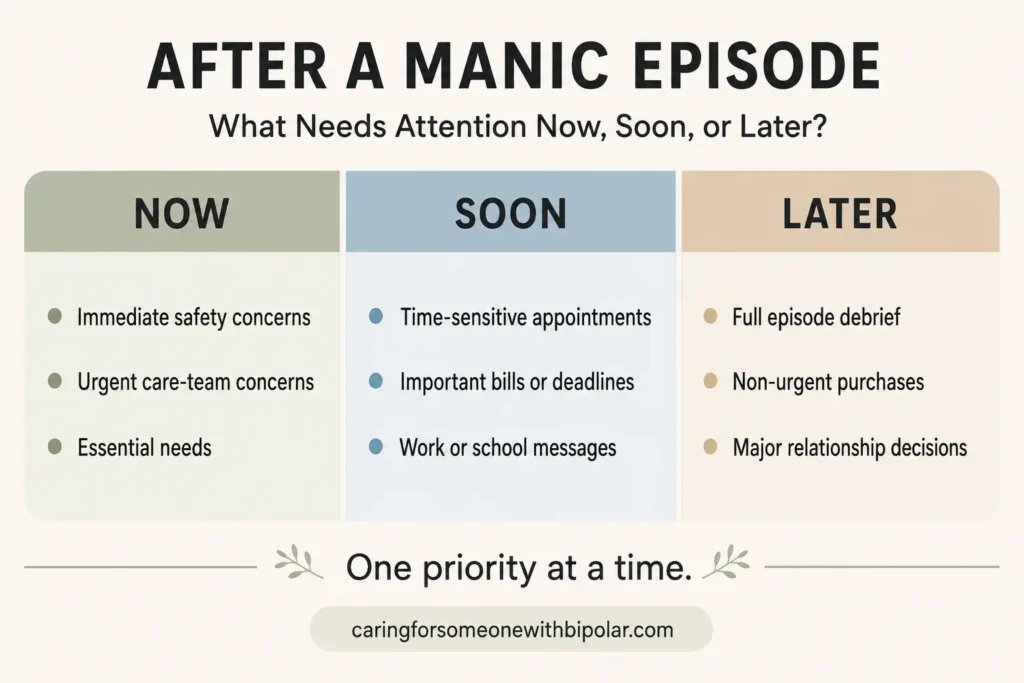
| Needs Attention Now | Can Be Handled Soon | Can Usually Wait |
|---|---|---|
| Immediate safety concerns | Time-sensitive appointments or commitments | A complete review of every event during the episode |
| Urgent health or care-team concerns | Bills, accounts, or practical matters with approaching deadlines | Non-urgent purchases or decisions that can be reconsidered later |
| Essential needs that cannot safely be postponed | Work, school, or social messages that genuinely require a response | Major relationship decisions that do not require an immediate answer |
This is a triage tool, not financial or legal advice. Significant financial, employment, contractual, or legal issues may require help from an appropriately qualified professional.
For a more detailed discussion of protecting shared finances without turning family support into control, see financial safeguards for a bipolar marriage.
How Can Relationships Begin to Repair After Mania?
There is no single conversation that automatically restores trust after a difficult episode. Relationship repair, when it is possible and wanted, may involve many smaller conversations and actions over time.
Start with one conversation, not the whole history
Choose the issue that currently matters most rather than reopening every past conflict. Keeping the conversation focused can make it easier for both people to understand what is actually being discussed.
Allow room for compassion and hurt
You can understand that someone has a mental health condition and still feel hurt by something that happened. Those realities do not cancel each other out.
Likewise, acknowledging harm does not require reducing a person to their worst moment.
Do not rush forgiveness
No one should be pressured to declare that everything is fine before they are ready. Some relationships recover gradually. Others need significant changes, stronger boundaries, or outside support.
Keep healthy boundaries
Recovery does not require caregivers to abandon limits that protect their wellbeing or safety. Boundaries should focus on what you will do and what you can participate in, rather than trying to control another person’s every decision.
For broader strategies outside the immediate aftermath of an episode, see communicating with someone who has bipolar disorder.
Consider professional support when appropriate
Some families or couples choose to work with a qualified mental health professional when communication, trust, or the impact of an episode feels difficult to navigate alone. The right type of support will depend on the people and circumstances involved.
What Should You Tell Children After a Difficult Episode?
Children do not need adult-level details about every event that occurred. Keep explanations calm, simple, age-appropriate, and free of blame.
It may also help to acknowledge that something difficult happened instead of expecting children to act as though they noticed nothing. Familiar routines and clear reassurance about what adults are doing to take care of the situation can provide a steadier environment.
For more detailed guidance, see supporting children of bipolar parents.
When Should You Update the Bipolar Emergency Plan?
When the situation is calmer and the person is willing and able to participate, the family can review what was learned from the episode.
Questions to consider include:
- What changes did we notice before the situation became more serious?
- What helped during the episode?
- What seemed to make communication harder?
- Which professional or personal contacts were useful?
- Are there practical safeguards that should be discussed or reviewed?
- What would the person want family members to know or do if similar concerns arise again?
Reviewing early warning signs of bipolar disorder may also help families think more clearly about what they observed, without assuming that every change is automatically a sign of another episode.
When possible, include the person living with bipolar disorder in planning so the document reflects their preferences and wishes rather than becoming a set of decisions made entirely about them.
For the full planning process, see the bipolar emergency plan guide.
Caregivers Need Recovery Too
The person who experienced mania is not the only one who may need time after the episode. Caregivers can also feel exhausted, relieved, angry, guilty, sad, or emotionally numb once the most intense period has passed.
You do not have to judge those feelings or immediately turn them into another problem to solve.
Think about what you need in order to recover some of your own stability. That may include rest, time away from caregiver responsibilities when possible, clearer boundaries, conversations with trusted people, peer support, or professional support for yourself.
NAMI also emphasizes the importance of caregivers finding support and making space for their own wellbeing. For a more focused guide, see bipolar caregiver burnout.
A Simple Family Recovery Checklist
This checklist is for organization only. It is not a treatment plan or a way to determine whether someone has medically recovered from a manic episode.
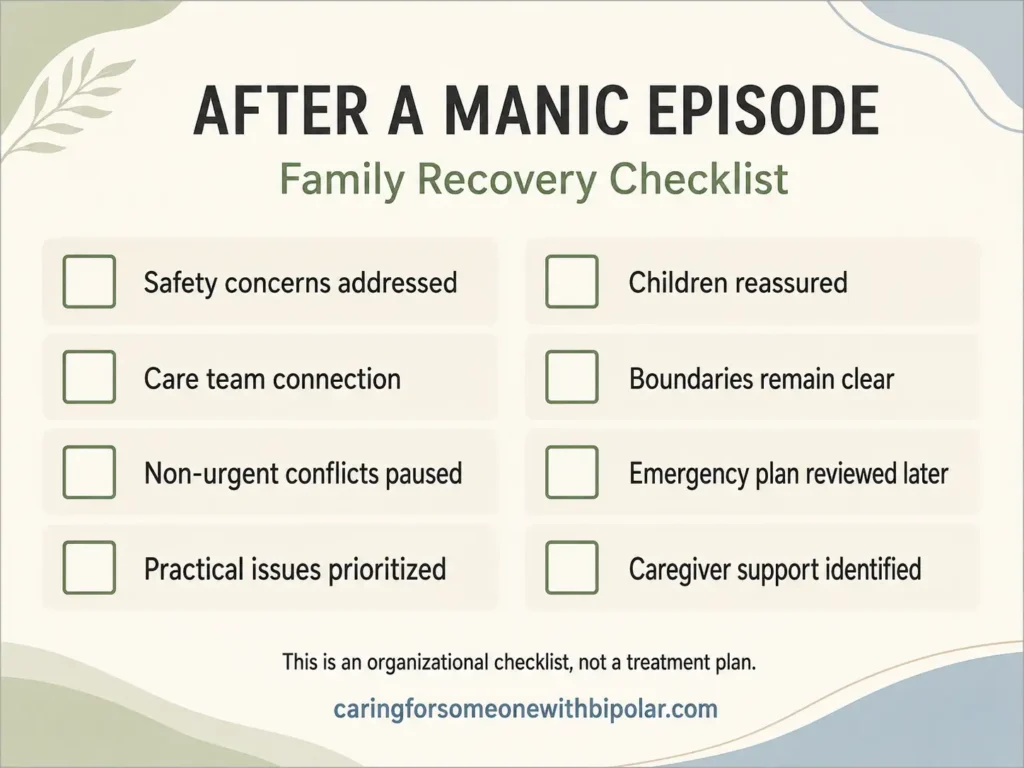
- Immediate safety concerns have been addressed.
- The person knows how to reconnect with their healthcare team.
- Non-urgent conflicts have been paused rather than forced.
- Practical problems have been sorted by urgency.
- Children have received calm, age-appropriate reassurance when relevant.
- Important family and personal boundaries remain clear.
- The emergency plan can be reviewed when the situation is calmer.
- The caregiver has identified their own support and recovery needs.
Trusted Resources
- National Institute of Mental Health: Bipolar Disorder
- NAMI: Supporting Recovery
- NAMI: Family Members and Caregivers
- 988 Suicide & Crisis Lifeline
Frequently Asked Questions
How long does it take to recover after a manic episode?
There is no universal recovery timeline. The course of bipolar disorder and the period after an episode vary from person to person. Families should avoid using a fixed deadline for when someone should be “back to normal” and bring ongoing concerns to the person’s healthcare team.
Is depression common after a manic episode?
Some people experience significant low mood or a depressive episode after mania, while others do not. A family member cannot determine from a quieter mood alone whether someone is experiencing a depressive episode, so persistent or concerning changes are better discussed with a healthcare professional.
Should you talk about what happened during the manic episode right away?
There is no single rule for every family. If there is no urgent issue that must be addressed, it may be reasonable to wait until both people have enough capacity for the conversation. Ask whether it is a manageable time, start with one issue, and avoid forcing a complete review of the episode all at once.
How can a family rebuild trust after a manic episode?
Trust may need to be rebuilt through consistent actions, honest conversations, accountability, and clear boundaries over time. Compassion does not require dismissing legitimate hurt, and no one should be pressured to forgive before they are ready. Some families also choose professional support when the impact is difficult to work through alone.
What should you do if concerning symptoms return after a manic episode?
Encourage the person to contact their healthcare team when symptoms persist, return, or cause concern. In the United States, call or text 988 if someone is experiencing a mental health crisis or if you are worried about a loved one and need crisis support. For immediate danger or a life-threatening emergency, call 911.
Final Takeaway
Recovery after mania is not a single conversation or a race back to normal. Families can move through the aftermath one priority at a time, beginning with safety and stability before working gradually through practical consequences, communication, and relationship repair.
The person living with bipolar disorder deserves dignity and appropriate professional support. Family members deserve space for their own feelings, boundaries, and recovery too.