How to Communicate With Someone Who Has Bipolar Disorder

Editorial note: This article is for educational support only. It is not a substitute for medical, mental health, crisis, legal, or safety advice. If there is immediate danger, call emergency services. If you are in the United States and you or someone else may be in crisis, call or text 988.
Communicating with someone who has bipolar disorder can feel confusing, especially when a calm conversation suddenly becomes tense, emotional, fast-moving, defensive, or painfully quiet. You may wonder whether to speak up, stay quiet, offer reassurance, set a boundary, or step away.
The goal is not to find perfect words that prevent every hard moment. The goal is to use calm, respectful language that helps you listen, stay clear, reduce escalation when possible, and protect your own emotional safety.
Bipolar disorder can involve manic, hypomanic, depressive, or mixed episodes. The National Institute of Mental Health explains that bipolar disorder can cause clear shifts in mood, energy, activity level, and concentration. Because of that, communication may feel different depending on whether your loved one is calm, elevated, irritable, overwhelmed, depressed, withdrawn, or in crisis.
This guide gives practical scripts, phrases to avoid, communication tools, text message examples, boundary language, and safety-aware steps for caregivers, partners, family members, and close friends. It is written to support better conversations, not to diagnose, treat, control, or replace professional care.
Quick Answer: How Do You Communicate With Someone Who Has Bipolar Disorder?
When communicating with someone who has bipolar disorder, use calm, specific, non-blaming language. Keep your sentences short during intense moments, validate the feeling without arguing about every detail, and set a clear limit if the conversation becomes hurtful, unsafe, or overwhelming.
Simple script: “I care about you, and I want to understand. I’m feeling overwhelmed, so I’m going to pause this conversation and come back when we are both calmer.”
Healthy communication does not mean agreeing with everything. It means staying respectful, avoiding shame, protecting safety, and knowing when a pause, boundary, therapist, doctor, support group, crisis line, or emergency help is needed.
At a Glance: What Helps and What Hurts
| What Helps | What Hurts |
|---|---|
| Using calm “I” statements | Blaming, diagnosing, or labeling them |
| Validating the feeling | Arguing about whether the feeling is logical |
| Keeping sentences short during intense moments | Giving long lectures during escalation |
| Taking a pause when emotions rise | Trying to win the argument |
| Setting clear limits when needed | Accepting threats, insults, or unsafe behavior |
| Talking about plans when things are calm | Waiting until crisis to decide what to do |
| Seeking support when safety is a concern | Trying to handle crisis moments alone |
Need exact boundary phrases? Read what to say when setting boundaries for calm scripts you can use in hard moments.
Before You Talk: 5 Questions to Ask Yourself
Before starting a difficult conversation, pause for a moment and ask yourself what kind of conversation this actually is. Some conversations are about listening. Some are about safety. Some are about a boundary. Some should wait until the person is calmer or more supported.
- Is this urgent, or can it wait? If it is not urgent, choose a calmer time.
- Am I trying to understand, correct, or control? Understanding usually works better than correcting in the middle of high emotion.
- Can I keep my own tone steady? If not, take a short pause first.
- Is this about safety? If there are threats, self-harm concerns, violence, psychosis, or medical danger, stop relying only on conversation and seek appropriate help.
- What is my one main message? Keep it simple. Hard conversations often fail when too many issues are raised at once.
Why Communication Can Feel Hard With Bipolar Disorder
Bipolar disorder can involve changes in mood, energy, sleep, activity level, concentration, and behavior. During manic, hypomanic, depressive, or mixed episodes, a person may communicate differently than they do when they are more stable.
That does not mean every difficult conversation is caused by bipolar disorder. It also does not mean hurtful behavior should be ignored. A diagnosis can help explain some patterns, but it does not remove the need for respect, safety, accountability, treatment support, and caregiver boundaries.
For caregivers and loved ones, the hardest part is often holding two truths at once: your loved one may be struggling, and you still need emotional safety.
Communication may change during mania or hypomania
During a manic or hypomanic period, conversations may feel faster, more intense, more impulsive, or harder to slow down. Your loved one may jump between ideas, become more irritable, reject concerns, take risks, or feel unusually certain about plans that worry you.
In those moments, long explanations usually do not help. Short, concrete, calm sentences are often easier to process than emotional speeches or debates.
Communication may change during depression
During a depressive period, your loved one may withdraw, answer briefly, avoid messages, seem hopeless, or say they do not want to talk. Pushing too hard can make them shut down more. Gentle, low-pressure language often works better.
You can still check on safety. If someone talks about not wanting to live, feeling like a burden, self-harm, or saying goodbye, treat that as serious and seek support.
Mixed symptoms can make conversations especially difficult
Mixed episodes can involve depressive and elevated symptoms at the same time. A person may seem agitated, restless, hopeless, angry, wired, or overwhelmed. These conversations may escalate quickly, so keep your words short and prioritize safety, support, and professional guidance.
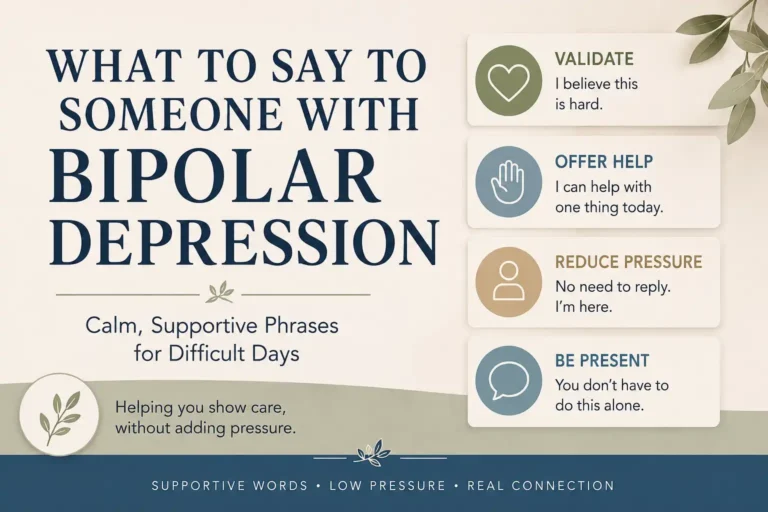
What to Say to Someone With Bipolar Disorder
The most helpful words are usually calm, specific, respectful, and realistic. You do not need to fix everything in one conversation. You can simply open a door, lower the emotional temperature, or protect a boundary.
| Situation | Try Saying This | Why It Helps |
|---|---|---|
| They are upset | “I can see this feels really intense right now.” | Validates the feeling without agreeing with every detail. |
| They are angry at you | “I want to understand, but I need us to speak without insults.” | Combines care with a clear limit. |
| They are talking very fast | “Can we slow down and focus on one thing at a time?” | Reduces overwhelm and brings the conversation back to one topic. |
| They are withdrawn | “You don’t have to explain everything. I’m here, and I can sit with you quietly.” | Offers presence without pressure. |
| They reject your concern | “I hear that you don’t see it the same way. I’m sharing this because I care about your safety.” | Avoids a power struggle while naming concern. |
| You need a pause | “I’m getting overwhelmed. I’m going to take 20 minutes and come back.” | Prevents escalation without abandoning the conversation. |
| You need a boundary | “I want to keep talking, but I won’t stay in a conversation where I’m being yelled at.” | Makes the limit clear and behavior-based. |
| You are worried about crisis | “I’m worried about your safety. Are you thinking about hurting yourself or someone else?” | Names the concern directly and opens the door to urgent help. |
What Not to Say, and What to Say Instead
Some phrases can sound dismissive, shaming, or controlling, even when you are trying to help. The safer approach is to focus on what you observe, how you feel, and what support or limit is needed.
| Avoid Saying | Say Instead |
|---|---|
| “Calm down.” | “I can see this is really intense. Let’s slow this down together.” |
| “You’re overreacting.” | “I can see this feels big right now. I want to understand what part feels most upsetting.” |
| “That’s your bipolar talking.” | “I’m noticing this conversation feels different than usual, and I’m concerned.” |
| “You’re acting crazy.” | “I care about you, and I’m worried about what’s happening right now.” |
| “Just think positive.” | “I know this feels heavy. I’m here with you, and we can take one step at a time.” |
| “Why can’t you just be normal?” | “I miss feeling connected to you. Can we talk about what support might help?” |
| “You always do this.” | “When this happens, I feel overwhelmed and unsure what to do.” |
| “If you loved me, you would stop.” | “I care about you, and I also need this behavior to change for the relationship to feel safe.” |
25 Calm Scripts for Hard Conversations
These scripts are starting points. Adjust them to fit your relationship, your safety, your loved one’s preferences, and any professional guidance you have received.
If they are angry and blaming you
Try:
- “I hear that you’re angry with me. I’m willing to talk, but I can’t continue if we’re attacking each other.”
- “I want to understand what hurt you. Let’s slow down so I can actually hear you.”
- “I’m not going to argue about everything right now. I care about you, and I want this conversation to stay safe.”
If they say you do not care
Try:
- “I do care. I may not be saying everything perfectly, but I am here and I want to understand.”
- “I can see why it might feel that way. My boundary is not a lack of love. It is how I keep this conversation safe.”
- “I care about you deeply, and I also need us to speak respectfully.”
If they are withdrawing
Try:
- “You don’t have to talk right now. I’m here, and I can check in later.”
- “Would it feel easier if I sat with you quietly instead of asking questions?”
- “I won’t push, but I do want to know you’re safe.”
If they are talking fast or jumping between topics
Try:
- “I want to follow what you’re saying. Can we stay with one topic for a minute?”
- “There are a lot of ideas here. Let’s write them down and choose the first thing to handle.”
- “I’m listening, and I also need us to slow the pace so I can understand.”
If they seem elevated, impulsive, or unusually energized
Try:
- “You have a lot of energy right now. I’m not here to argue, but I am worried about sleep and safety.”
- “Let’s pause major decisions tonight and talk again tomorrow.”
- “I know this feels urgent. I would feel better if we waited before spending money, driving far, quitting a job, or sending big messages.”
If they are depressed or hopeless
Try:
- “You don’t have to carry this alone.”
- “I’m here with you. We do not have to solve everything tonight.”
- “I’m worried because you sound like you’re in a lot of pain. Are you thinking about hurting yourself?”
If you need to set a boundary
Try:
- “I want to talk, but I won’t stay in a conversation where I’m being insulted.”
- “I’m going to step away now. I’ll come back when we can speak calmly.”
- “I can support you, but I cannot be the only person you rely on.”
If you need to end the conversation for now
Try:
- “This conversation is getting too intense. I’m going to pause now.”
- “I love you, and I’m not able to continue this safely right now.”
- “We can return to this later. Right now, I need space to calm my body and think clearly.”
Use Validation Without Agreeing With Everything
Validation means acknowledging the emotion. It does not mean agreeing with every belief, accusation, plan, or interpretation.
For example, if your loved one says, “Everyone is against me,” you do not have to say, “Yes, everyone is against you.” You can say:
“That sounds frightening and lonely. I’m not seeing it exactly the same way, but I believe that it feels very real to you right now.”
This kind of response does three things at once:
- It acknowledges the emotional pain.
- It avoids arguing over every detail.
- It keeps you honest about your own perspective.
Validation is especially useful when the conversation is emotionally intense. It can reduce defensiveness and make it easier to move toward the next step.
Use “I” Statements Instead of Blame
“I” statements help you speak clearly without sounding like you are attacking the person’s character. They are especially useful when you need to name a problem, set a boundary, or explain how something affects you.
| Instead of | Try |
|---|---|
| “You never listen.” | “I feel unheard when I’m interrupted.” |
| “You’re being impossible.” | “I’m feeling overwhelmed and need us to slow down.” |
| “You’re ruining everything.” | “I’m scared about the impact this situation is having on our family.” |
| “You need to stop acting like this.” | “I need this conversation to stay respectful if we’re going to continue.” |
| “You’re manic again.” | “I’m noticing less sleep, faster speech, and bigger plans than usual. I’m concerned.” |
When you are unsure whether the behavior is related to bipolar symptoms, drug use, alcohol use, or both, it is usually safer to start with observations instead of labels. Read how families can talk about bipolar disorder or drug use without accusing.
For more examples, read how to set boundaries with someone with bipolar disorder.
How to Communicate During a Possible Manic or Hypomanic Episode
If your loved one seems unusually energized, irritable, impulsive, grandiose, restless, or unable to slow down, avoid long debates. During possible mania or hypomania, your communication goal is not to prove that you are right. Your goal is to reduce risk, keep words simple, and avoid feeding escalation.
Try to:
- Use short, clear sentences.
- Keep your tone steady.
- Avoid arguing about every idea.
- Focus on sleep, safety, money, driving, conflict, medication concerns, and professional support.
- Delay major decisions when possible.
- Step away if the conversation becomes unsafe.
Script: “I hear that this feels urgent. I’m not comfortable making a big decision tonight. Let’s write it down, sleep, and talk again tomorrow.”
Another script: “I’m not here to fight with you. I am worried because you haven’t slept much and this plan could affect your safety.”
When not to debate
Debating can make some intense conversations worse. If your loved one is moving quickly from topic to topic, seems unusually certain, or becomes more agitated each time you challenge them, try redirecting instead of arguing.
Try: “I can see this matters a lot. Right now, I want to focus on what helps you stay safe tonight.”
How to Communicate During Depressive Withdrawal
Depression may make communication feel slow, heavy, or one-sided. Your loved one may not have energy to explain, reassure you, answer questions, or make decisions. Try to lower the pressure.
Helpful phrases include:
- “You don’t have to explain everything right now.”
- “I’m here with you.”
- “Would food, water, a blanket, or quiet company help?”
- “I can check in later instead of asking a lot of questions now.”
- “I’m worried about your safety. Are you thinking about hurting yourself?”
Avoid turning the conversation into a motivational speech. Phrases like “just be positive” or “you have so much to be grateful for” can feel dismissive. Support is often more helpful when it is simple, steady, and practical.
Text Message Scripts for Someone With Bipolar Disorder
Texting can help when an in-person conversation feels too intense. Keep messages short and avoid sending repeated paragraphs during conflict.
| Situation | Text Message You Can Send |
|---|---|
| Gentle check-in | “Thinking of you. No pressure to reply quickly. I just wanted you to know I’m here.” |
| Depressive withdrawal | “You don’t have to explain. Can you just send one word or emoji so I know you’re safe?” |
| Escalating conflict | “I care about you, but this is getting heated. I’m going to pause texting and come back later.” |
| Boundary | “I want to talk, but I won’t continue if the messages include insults or threats.” |
| Possible mania or impulsive plan | “I hear that this feels urgent. I’m asking that we wait before making a major decision.” |
| Safety concern | “I’m worried about your safety. Are you thinking about hurting yourself or someone else?” |
| After a hard conversation | “I’m still here. I want us to repair this when we’re both calmer.” |
What to Do When the Conversation Is Escalating
Escalation can happen quickly. Voices rise, messages become harsh, accusations repeat, or one person refuses to pause. The safest response is often to stop adding fuel.
Try this three-step approach:
- Name the shift: “This conversation is getting more intense.”
- State your limit: “I can’t continue while we are yelling.”
- Give the next step: “I’m going to take a break and come back at 7:00.”
Script: “I care about solving this, but we are not solving it while we are both this upset. I’m going to pause now and return later.”
A pause is not punishment. It is a way to protect the relationship from more damage.
When They Refuse to Talk or Refuse Help
Sometimes your loved one may refuse to talk, deny there is a problem, reject treatment, ignore messages, or accuse you of trying to control them. This is painful and frightening, especially when you can see warning signs.
In that moment, avoid turning the conversation into a trial. Instead, focus on what you can control: your words, your boundaries, your safety steps, and your support system.
Try:
- “I hear that you don’t want help right now. I’m still worried, and I’m going to make choices that keep our home safe.”
- “I can’t force you to talk, but I can tell you what I’m seeing and what I’m worried about.”
- “I’m willing to support treatment. I’m not willing to pretend everything is fine when I’m scared.”
For a deeper plan, read what to do when someone with bipolar disorder refuses help.
Understand the Context Without Accepting Harm
It is possible to be compassionate and still have limits. Your loved one may say hurtful things during intense mood symptoms. Understanding that context may help you respond with less shock, but it does not mean you must accept threats, intimidation, repeated verbal abuse, financial harm, or unsafe behavior.
A helpful boundary separates the person from the behavior:
“I love you. I’m not okay with being threatened.”
“I care about what you’re going through. I still need this conversation to be respectful.”
“I understand that you’re hurting. I’m not able to be yelled at for an hour.”
If supporting starts turning into rescuing, covering up, or absorbing harm, read how to support someone with bipolar without enabling.
When to Pause the Conversation
Pausing is one of the most useful communication tools for caregivers. You do not have to stay in every conversation until it reaches a conclusion.
Pause the conversation if:
- Either person is yelling, insulting, threatening, or panicking.
- The conversation is going in circles.
- You are becoming too activated to speak calmly.
- Your loved one is becoming more agitated with every reply.
- You are trying to discuss a major decision during an intense moment.
- You feel unsafe.
Script: “I’m going to pause because I don’t want us to hurt each other more. I’ll come back when I’m calmer.”
If you say you will come back later, try to follow through when it is safe. Predictable pauses help build trust.
When Communication Becomes a Safety Concern
Some moments require more than communication skills. If there is danger, do not focus on finding the perfect sentence. Focus on safety and support.
Seek immediate help if there are:
- Threats of self-harm or suicide.
- Threats toward another person.
- Violence, weapons, or physical intimidation.
- Psychosis, extreme confusion, or inability to stay safe.
- Dangerous driving, spending, substance use, or risky behavior that could cause immediate harm.
- A medical emergency.
If you are in the United States and someone may be in suicidal crisis or emotional distress, call or text 988 Suicide & Crisis Lifeline. You can also visit SAMHSA’s 988 resource page. If there is immediate danger, call emergency services.
For family planning, read bipolar emergency plan for families.
Long-Term Communication Habits That Build Trust
The best time to plan for hard conversations is not during the hardest conversation. Talk about communication when things are calmer.
Use check-ins when things are calm
A calm check-in might sound like:
“When things get intense, what helps you feel less cornered?”
“What words make things worse for you?”
“If I’m worried about sleep, spending, or safety, how would you prefer I bring it up?”
These conversations can help you avoid guessing in the future.
Agree on support before a crisis
If your loved one is willing, discuss what kind of support is acceptable during warning signs. This might include contacting a therapist, psychiatrist, trusted relative, support group, primary care doctor, or crisis resource.
Questions to ask during a stable time:
- “Who do you trust if things get intense?”
- “What signs should we pay attention to?”
- “What helps you when you are not sleeping?”
- “What should I avoid saying?”
- “What should I do if I’m worried about your safety?”
Keep your own support system
You need support too. Caregivers often become isolated because they are trying to protect the person they love, the family, and the truth of what is happening.
Consider support from a therapist, trusted friend, faith leader, caregiver group, or family support organization. NAMI Family Support Group may be a helpful place to start if you are in the United States.
If you are exhausted, resentful, numb, anxious, or constantly walking on eggshells, read bipolar caregiver burnout.
Helpful Tools for Caregivers
Use these tools when you feel stuck, overwhelmed, or unsure what to say next.
| Tool | How to Use It | Example |
|---|---|---|
| One-sentence focus | Decide your main message before speaking. | “I’m worried about safety tonight.” |
| Validation phrase | Name the emotion without agreeing to everything. | “That sounds really upsetting.” |
| Pause script | Stop escalation before it gets worse. | “I’m going to take a break and come back later.” |
| Boundary line | Name what you will or will not do. | “I won’t stay in a conversation with threats.” |
| Support list | Keep trusted contacts and crisis resources ready. | Therapist, doctor, relative, 988, emergency services. |
| After-action note | Write down what helped and what made things worse. | “Short texts helped. Long explanations escalated.” |
What If You Keep Saying the Wrong Thing?
You will not handle every conversation perfectly. Caregiving under emotional pressure is hard. You may say too much, speak too sharply, freeze, cry, defend yourself, or try to fix everything at once.
Repair matters. If it is safe, you can come back later and say:
“I’ve been thinking about our conversation. I wish I had said that more calmly. I’m sorry for my part. I still want us to talk about the issue, but I want to do it in a better way.”
Repair does not mean taking blame for everything. It means owning your part while still keeping the conversation honest.
Next Guides to Read
- What to Say When Setting Boundaries With Someone Who Has Bipolar Disorder
- How to Set Boundaries With Someone With Bipolar Disorder
- How to Support Someone With Bipolar Without Enabling
- What to Do When Someone With Bipolar Disorder Refuses Help
- Bipolar Caregiver Burnout: Signs, Boundaries, and Support
- Bipolar Emergency Plan for Families
Frequently Asked Questions
What should I say to someone with bipolar disorder during a hard conversation?
Use calm, specific language. Try: “I care about you, and I want to understand. I need us to slow down so this conversation stays safe for both of us.” Keep your words short if emotions are high.
What should you not say to someone who has bipolar disorder?
Avoid phrases like “calm down,” “you’re overreacting,” “that’s your bipolar talking,” “you’re crazy,” or “it’s all in your head.” These phrases can sound dismissive, shaming, or invalidating.
How do you talk to a bipolar person without making things worse?
Start with a calm tone, use short sentences, validate the feeling, and avoid arguing about every detail. If the conversation escalates, pause instead of pushing harder.
How do you communicate during a manic episode?
Keep sentences short, avoid long debates, and focus on immediate safety, sleep, risky decisions, and clear limits. If the situation feels unsafe or crisis-related, seek appropriate professional or emergency support.
How do you communicate during a depressive episode?
Use gentle, low-pressure language. Try: “I’m here with you. You don’t have to explain everything right now.” Watch for safety concerns, especially talk of self-harm, suicide, hopelessness, or feeling like a burden.
How do I set a boundary without making things worse?
Use an “I” statement and name your next step. For example: “I want to talk, but I can’t continue while we’re yelling. I’m going to take a break and come back later.”
Can bipolar disorder make someone say hurtful things?
During intense mood symptoms, some people may say things that are hurtful or out of character. That context may help you respond more calmly, but it does not excuse threats, verbal abuse, intimidation, or ongoing disrespect.
Should I bring up bipolar disorder during an argument?
Be careful. Saying “you’re bipolar” or “this is your bipolar talking” can feel blaming. It is usually better to name what you observe: “I’m noticing very little sleep, faster speech, and a lot of urgent plans. I’m concerned.”
What if they refuse to talk?
Do not force a long conversation. You can say, “I won’t push you to talk right now, but I do want to know you’re safe.” If there are warning signs or safety concerns, contact appropriate support.
When should I seek professional or crisis help?
Seek outside help if there are threats of self-harm, threats toward others, violence, a medical emergency, psychosis, severe confusion, or repeated conflict that feels unsafe or unmanageable. If there is immediate danger, call emergency services. In the United States, call or text 988 for crisis support.
Sources and Support Resources
This guide references public information from the National Institute of Mental Health, NCBI Bookshelf communication guidance for manic episodes, SAMHSA 988 resources, 988 Suicide & Crisis Lifeline, and NAMI Family Support Group.
Final Takeaway
Communication with someone who has bipolar disorder works best when it is calm, clear, respectful, and realistic. You can validate feelings without agreeing with everything. You can listen with compassion while still protecting your own limits.
Start with one steady sentence. Pause when the conversation escalates. Use boundaries when needed. If safety becomes a concern, stop trying to find the perfect words and seek appropriate support.