My Story as Elena

Elena is the name I use here to protect my family’s privacy and my own.
I cannot tell every detail of my story. I will not share names, exact dates, locations, private messages, legal details, or anything that could expose my loved one or the people around him.
But I can tell you this: the fear was real. The exhaustion was real. The love was real. And the lessons I learned as a caregiver are the reason this site exists.
When Love Becomes a Storm
I am a mother who has supported someone I love through bipolar disorder, substance use disorder, emotional instability, crisis moments, and treatment refusal.
For a long time, I lived in a state of alert. I never knew which version of the day would arrive.
Some days felt calm enough to breathe. Other days changed suddenly, and the whole family had to adjust around the mood, the fear, the anger, the silence, the money pressure, or the next unexpected crisis.
It was not only about bipolar disorder. It was not only about addiction. Sometimes the hardest part was not knowing where one ended and the other began.
I often asked myself the question many families ask in private:
Is this bipolar disorder, drug use, or both?
The Pain Families Do Not Always Say Out Loud
Before living this, I did not fully understand how much a mental health crisis can affect an entire family.
One person may be diagnosed, but everyone around them feels the impact.
Parents lose sleep. Partners carry fear. Siblings feel forgotten. Children may see more than they should. Relatives may not understand. Neighbors may notice the chaos. And the caregiver is often left trying to hold everything together.
There were moments when I felt guilty for being tired, ashamed of my anger, and desperate for a little peace. Saying no felt painful, and I often wondered how much more I could survive.
That is one of the reasons I write.
Because caregivers need a place where their pain is not minimized.
Why I Could Not Find the Help I Needed
When I searched for help, I found many articles explaining bipolar disorder from a clinical point of view.
Those articles were useful, but they did not always speak to the private reality of families living through bipolar disorder and substance use at the same time.
I needed answers to questions like:
- What do I do when I cannot tell if this is mania, drugs, or both?
- Should I give money if I fear it may increase the risk?
- How do I set boundaries without feeling like I am abandoning someone?
- How do I protect children from crisis moments?
- How do I keep loving someone without losing myself?
- What should I do when my loved one refuses treatment?
- How do I survive the emotional rollercoaster without becoming hardened?
Judgment was not what I needed. False hope did not help either. What I was searching for were honest words, practical support, and safety-focused guidance.
What I Learned About Boundaries
One of the hardest lessons I had to learn is that love does not mean saying yes to everything.
For a long time, I thought support meant rescue. I thought if I gave more, explained more, forgave more, or sacrificed more, things might finally change.
But addiction and crisis can turn love into a cycle of fear, pressure, and emotional exhaustion.
I learned that a boundary is not the end of love.
A boundary is a safety line.
Love can sound like, “I will help you find support.”
It can also sound like, “I cannot give you money.”
And sometimes, the most loving sentence is, “I will not let this crisis take over the whole family.”
And sometimes love means stepping back enough to protect your own heart, your home, and the people who depend on you.
Why I Protect the Details
I share from lived experience, but I do not share everything.
My loved one is not defined only by his illness, his addiction, or the hardest moments our family has lived through.
That is why I use a pen name and protect identifying details. My goal is to share caregiver lessons with honesty while preserving my family’s dignity.
I believe it is possible to tell the emotional truth without sacrificing someone’s dignity.
Who This Site Is For
This site is for the parent who feels scared every time the phone rings.
Partners may find words for the instability they have been carrying. Siblings may recognize the pain of feeling invisible when one person’s crisis takes all the space.
Grandparents may come here while trying to protect a child from adult chaos. Friends may be looking for a safer way to help.
And caregivers who love deeply, but feel tired of living in survival mode, may finally feel seen.
What I Hope You Find Here
I cannot promise easy answers.
I cannot promise that your loved one will accept help, stop using substances, stay in treatment, or suddenly understand your pain.
But I can offer you a place where your experience is taken seriously.
Here, you will find guides about bipolar disorder, addiction, crisis planning, boundaries, money pressure, family impact, treatment refusal, caregiver burnout, and emotional survival.
Most of all, I hope you find language for what you have been carrying alone.
A Safety Note
I am not a doctor, therapist, addiction specialist, attorney, or crisis worker. I write from lived caregiver experience and from carefully selected mental health resources.
This site is for education and support only. It does not diagnose, treat, or replace professional care.
If your loved one may hurt themselves or someone else, or if you feel unsafe, contact emergency services right away. In the United States, you can call or text 988 for suicide, mental health, emotional distress, or substance use crisis support.
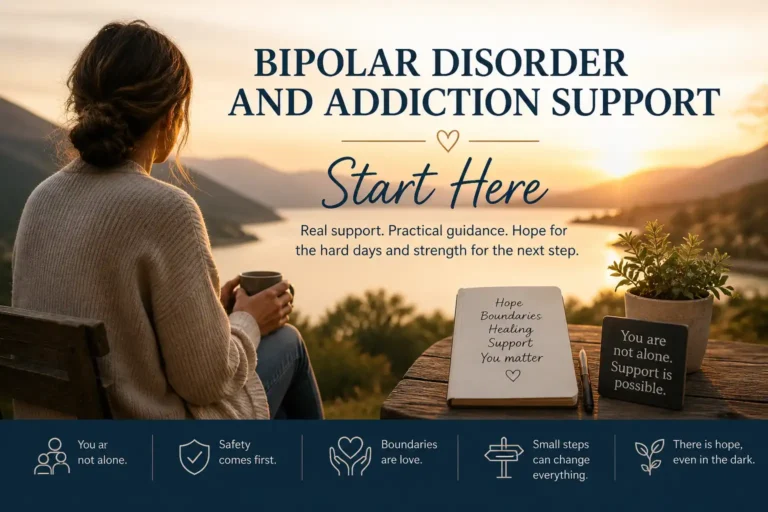
Start Here
If you are new here, these guides may help you begin:
- Start Here: Bipolar Disorder and Addiction Family Support
- Bipolar Disorder and Addiction: A Family Guide
- Is It Bipolar Disorder, Drug Use, or Both?
- Setting Boundaries With Someone With Bipolar Disorder
- Bipolar Emergency Plan
Being tired does not make you weak.
Needing boundaries does not make you cruel.
And not being able to fix everything does not mean you are alone.
With care and solidarity,
Elena
A mother and caregiver learning one step at a time