What to Say During a Manic Episode: 7 Scripts That Can Help

Safety first: This article is for caregiver support and education only. It is not medical, psychiatric, legal, or emergency advice. It cannot replace a psychiatrist, therapist, crisis team, or emergency services.
If someone is threatening violence, talking about self-harm, trying to drive while severely impaired, experiencing severe paranoia or psychosis, or you feel unsafe, call emergency services immediately. In the U.S., call or text 988 for the Suicide & Crisis Lifeline, or call 911 in a life-threatening emergency.
Quick Answer: What Should You Say During a Manic Episode?
During a manic episode, use calm, short, validating phrases. Avoid arguing, shaming, diagnosing, or trying to prove the person wrong. Your goal is not to “win” the conversation. Your goal is to reduce escalation, delay risky decisions, protect safety, and involve professional help when needed.
A helpful phrase is: “I can tell this feels important right now. I want to understand, and I also want us to stay safe. Can we pause, write this down, and come back to it tomorrow?”
It was 3:17 AM on a Thursday.
My partner had not slept in more than a day. He was pacing our living room, talking faster than I could follow, jumping from one idea to the next — a business plan, a road trip, a sudden purchase, a theory about why everyone was “holding him back.”
I was exhausted. I was scared. And I made almost every mistake a caregiver can make.
I told him to calm down.
Then I said he was not making sense.
Out of fear and exhaustion, I pushed harder and told him he needed to sleep.
And yes — I used the word “manic” like a weapon.
It did not help. It made everything worse.
That night taught me something I wish every caregiver knew earlier: during a manic episode, words can either lower the emotional temperature or throw gasoline on it. The right words will not stop the episode. They will not replace treatment. They will not magically restore insight. But they can help you avoid an unnecessary fight, delay a dangerous decision, and keep both of you safer until professional support is involved.
This guide gives you seven caregiver scripts for common manic-episode situations: big decisions, rapid talking, accusations, leaving the house at night, impulsive spending, verbal aggression, and refusing treatment. Use them as starting points. Adapt them to your relationship, your safety plan, and the advice of your loved one’s treatment team.
Before the Scripts: The Golden Rule
Your goal is not to reason with mania. Your goal is to reduce escalation and protect safety.
Mania can affect sleep, judgment, impulse control, emotional regulation, spending, risk perception, and the ability to process disagreement. Someone in a manic episode may feel unusually energized, irritable, brilliant, persecuted, invincible, or deeply misunderstood.
That does not mean you should agree with everything they say. It also does not mean you should argue with every distorted thought in real time.
In the middle of an episode, your most useful tools are usually:
- calm tone
- short sentences
- emotional validation
- clear safety boundaries
- time delays for risky decisions
- reduced stimulation
- professional or crisis support when needed
What usually makes things worse?
- arguing facts aggressively
- using “manic” as an accusation
- mocking grandiose ideas
- saying “calm down”
- cornering them with ultimatums
- matching their volume
- making promises you cannot keep
- trying to manage a dangerous crisis alone
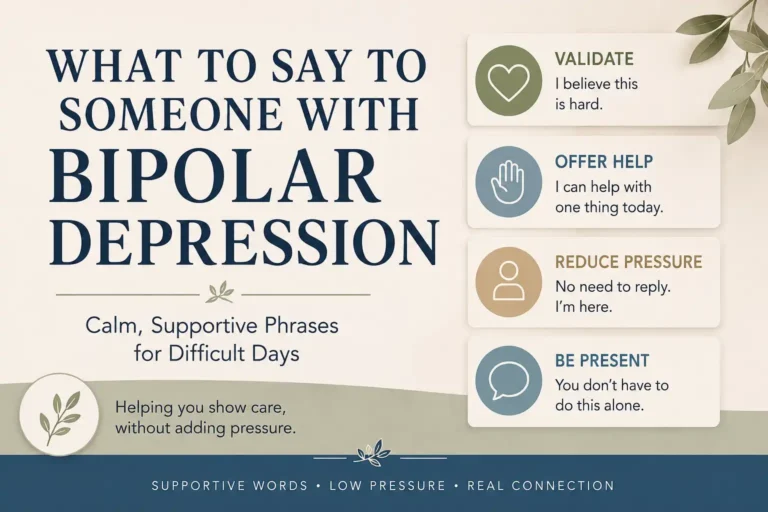
What to Say vs. What Not to Say During Mania
| Situation | Try Saying | Avoid Saying |
|---|---|---|
| They want to make a big decision tonight | “Let’s write it down and revisit it tomorrow when we’re both rested.” | “That’s a terrible idea.” |
| They are talking rapidly | “I want to follow you. Can we slow down a little so I can understand?” | “You’re not making sense.” |
| They accuse you of not supporting them | “I love you, and I’m on your side. I know it may not feel that way right now.” | “That’s just the mania talking.” |
| They want to leave or drive at night | “I’m worried about your safety. Can we stay here, sit outside, or walk together instead?” | “I forbid you to leave.” |
| They are spending impulsively | “Let’s use our 24-hour rule before making this purchase.” | “You’re wasting money again.” |
| They become verbally aggressive | “I’m leaving this conversation, not leaving you. I’ll come back when voices are lower.” | “How dare you talk to me like that?” |
| They refuse treatment | “I can’t manage this alone. We need to involve your treatment team today.” | “If you loved me, you’d take your meds.” |
Script 1: When They Want to Make a Big Decision Tonight
The scenario: Your partner wants to quit their job, buy a car, book a flight, start a business, or make another life-altering decision — and they want to do it now.
What NOT to say:
- “You are manic. You cannot make this decision right now.”
- “That is a terrible idea.”
- “You will regret this tomorrow.”
- “You are not thinking clearly.”
Why these fail: They trigger shame and defensiveness. Mania already feels euphoric and invincible. Telling someone they are impaired is interpreted as an attack on their brilliance, not a medical observation.
The script:
“I can tell this idea is really important to you, and I want to give it my full attention. I am having trouble keeping up with the details right now because I am so tired. Can we write this down together and revisit it tomorrow at 10 AM? I want to make sure I understand it completely before we move forward.”
Why this works:
- Validates the emotion without validating the plan.
- Introduces a time delay — mania thrives on urgency. Delay is your ally.
- Shifts responsibility to your limitations (“I am tired”) rather than their impairment.
- Uses “we” language — collaboration, not opposition.
- Creates a concrete future checkpoint — by tomorrow, urgency often decreases.
What I actually did:
The first time I used this script, my partner was trying to buy $4,000 in camera equipment at 2 AM. I said the words exactly as written. He paused. He said, “You never take my ideas seriously.” I repeated: “I want to. I need sleep to do that. 10 AM.” He wrote the items in his Notes app. At 10 AM, he had slept four hours and said, “I don’t know why I wanted all that.” The purchase never happened.
Script 2: When They Are Pacing and Talking Rapidly
The scenario: Your partner cannot stop moving or talking. They are chain-smoking, cleaning obsessively, or circling the room while monologuing. Your presence feels required as an audience.
What NOT to say:
- “Stop pacing. You are making me anxious.”
- “Can you just sit down?”
- “You are talking too fast. I cannot understand you.”
- “Why won’t you listen to me?”
Why these fail: They demand physical and cognitive control that mania has disabled. You are asking someone with a broken brake pedal to stop the car.
The script:
“I can see you have a lot of energy right now, and a lot on your mind. I want to hear you, but I am getting overwhelmed by the speed. Can we sit down together? If you slow down just a little, I can follow better, and I think I will be more helpful.”
Alternative if sitting is refused:
“I am going to sit down while you talk. I can listen better when I am not standing. Keep going — I am still here.”
Why this works:
- Does not demand they change — you change your position, reducing tension.
- Acknowledges their energy without pathologizing it.
- Models the behavior you want (sitting, slowing) rather than commanding it.
- Gives them an audience — mania often needs witness. You are providing it on your terms.
What I actually did:
During one episode, my partner paced for three hours, talking about a conspiracy theory involving our landlord. I sat on the floor — below his eye level, non-threatening — and said, “I am listening. I am just going to sit because my legs hurt.” He kept talking. I did not agree or disagree. I said, “I hear you,” every few minutes. Eventually, he sat beside me. The energy dropped just enough that I could suggest a shower — which he accepted.
Script 3: When They Accuse You of Not Supporting Them
The scenario: Your partner interprets your caution, boundaries, or fatigue as betrayal. They say things like: “You never believe in me,” “You are just like my parents,” “You want me to fail,” or “You are jealous of my energy.”
What NOT to say:
- “That is the mania talking.”
- “You are being paranoid.”
- “I have supported you for years — how dare you?”
- “You are delusional.”
Why these fail: They invalidate the person’s emotional reality. Even if the accusation is medically influenced, the feeling of betrayal is real to them. Invalidating it escalates conflict and deepens their isolation.
The script:
“I love you, and I am on your side. I know it does not feel that way right now, and that is breaking my heart. I am not saying no to you. I am saying I need us both to be safe before we move forward. My hesitation is not about your idea — it is about making sure we both land safely on the other side.”
Why this works:
- Affirms love and alliance first — the deepest fear in mania is abandonment.
- Acknowledges their feeling without agreeing with the accusation.
- Reframes hesitation as care rather than opposition.
- Uses “we” and “both” — reinforces partnership, not hierarchy.
What I actually did:
My partner once screamed, “You want me medicated into a zombie because you cannot handle my success!” I felt my throat close with rage. Instead of defending myself, I said: “I love you. I am not your enemy. I am scared, not jealous. And I need us both to survive this week.” He stared at me for 30 seconds. Then he said, quieter, “I am scared too.” That was the first time he named fear during mania. It did not end the episode. But it lowered the temperature enough that I could suggest calling his psychiatrist in the morning.
Script 4: When They Want to Leave the House at 3 AM
The scenario: Your partner wants to drive, walk, or travel somewhere — often with no clear destination — in the middle of the night. This is one of the highest-risk situations: impaired judgment + motor vehicles + exhaustion.
What NOT to say:
- “You are not going anywhere.”
- “I am calling the police.” (unless safety is immediately threatened)
- “You will get yourself killed.”
- “You cannot leave. I forbid it.”
Why these fail: They trigger a power struggle. Mania responds to restriction with escalation. Your partner may leave just to prove autonomy.
The script:
“I know you want to go out, and I understand that feeling. I am asking you to stay because I am worried about your safety, and I do not want to be here alone worrying. If you need to move, can we walk around the block together? Or can I make you tea and we sit on the porch? I need you here tonight.”
Why this works:
- Validates the urge — mania creates genuine physical restlessness. Denying the urge entirely increases agitation.
- Offers a substitution — movement without danger (walk around block, porch).
- Frames the request as your need (“I need you here”) rather than their limitation.
- Avoids commands — requests preserve autonomy.
If they insist on driving:
This crosses into safety territory. The script changes:
“I am not comfortable with you driving right now because I am afraid you will get hurt. If you leave in the car, I will need to call [sister/friend/crisis line/911] because I cannot manage this worry alone. I do not want to do that. I want us to figure this out together.”
What I actually did:
At 2:30 AM, my partner put on shoes and said he was driving to the ocean — three hours away. I used the first script. He refused. I used the second. He paused. I said, “If you get in that car, I will have to call your sister because I will not sleep until I know you are safe, and I cannot stay awake all night.” He sat on the porch for 20 minutes. I sat with him, silent. Then he came inside and watched TV until dawn. The car stayed parked.
Script 5: When They Are Spending Money Impulsively
The scenario: Online shopping, crypto investing, or planning expensive purchases during a manic episode. Financial harm is often irreversible and creates long-term stress for both partners.
What NOT to say:
- “You are wasting our money.”
- “You are irresponsible.”
- “Give me your credit cards.” (unless pre-negotiated in a crisis contract)
- “You will bankrupt us.”
Why these fail: They trigger shame about behavior that mania frames as brilliant, necessary, or urgent. Shame often increases impulsivity as the person tries to “prove” their competence.
The script:
“I can see that this purchase feels really important and time-sensitive right now. Our agreement is that purchases over $100 need a 24-hour waiting period so we both feel good about them. I am not saying no. I am saying let us sleep on it and look at it together tomorrow. If it still feels right then, we will figure it out.”
Why this works:
- References a pre-existing agreement — this is why crisis contracts matter. It is not you imposing a rule in the moment; it is both of you honoring a previous commitment.
- Does not say no — says “later,” which mania can sometimes tolerate.
- Promises collaboration — “we will figure it out together” reduces the adversarial dynamic.
If there is no pre-existing agreement:
“I want to support what you need, and I am also worried about our finances right now. Can we look at our budget together before deciding? I need to feel secure about this, and I think you do too.”
What I actually did:
My partner once spent $1,200 on online courses at 4 AM. By morning, the receipts were sitting in my inbox.
We did not have a crisis contract yet, and confronting him during the episode would only have turned the purchase into another fight. So I waited. Once he was stable, we talked about what happened and used that moment to build the boundary system we now rely on.
Prevention is always better than intervention, but if you are reading this during an active episode, use the delay tactic above.
Script 6: When They Become Verbally Aggressive
The scenario: Yelling, name-calling, threats, or intense criticism directed at you. This is often the most painful part of caregiving because it feels personal, even when you know it is medically driven.
What NOT to say:
- “You are abusive.”
- “How dare you speak to me like that?”
- “I am done with you.”
- “You are just like your [parent/ex].”
Why these fail: They escalate the conflict. Mania + shame + anger is a dangerous cocktail. Your hurt is valid, but expressing it in the moment often increases danger.
The script:
“I love you, and I am not going to stay in this conversation while voices are raised. I am going to [the bedroom / the kitchen / outside]. When you are ready to talk without yelling, I am ready to listen. I am not leaving you. I am leaving this specific moment.”
Then: leave.
Why this works:
- Separates the person from the behavior — “I am leaving the yelling, not you.”
- Gives a clear, achievable path back — “when you are ready to talk without yelling.”
- Removes the audience — mania-fueled aggression often feeds on reaction. Removing yourself deprives it of fuel.
- Protects your safety — verbal aggression can escalate. Distance is protection.
Critical follow-up:
When your partner is stable, have a conversation about boundaries. This script is for survival during an episode. It is not a long-term communication strategy. If verbal aggression is recurring, it requires clinical intervention — medication adjustment, therapy, or crisis planning.
What I actually did:
The first time my partner yelled during mania, I yelled back. I matched his volume. It escalated until he punched a wall. After that, I developed this script. The next episode, when he started yelling, I said the words, walked to the bedroom, and closed the door. He yelled for five more minutes. Then silence. Twenty minutes later, he knocked and said, “I am sorry. I do not know why I am so angry.” That was the first time he accessed insight during an episode. It would not have happened if I had stayed and fought.
Script 7: When They Refuse Medication or Treatment
The scenario: Your partner stops taking medication, refuses to call their psychiatrist, or rejects the idea that they are experiencing an episode. This is one of the most dangerous moments because it cuts off the primary route to stabilization.
What NOT to say:
- “You are being stupid.”
- “Your doctor said you have to take this.”
- “If you loved me, you would take your meds.”
- “You are going to ruin everything.”
Why these fail: They frame medication as a moral obligation or a tool of control. Mania often comes with anosognosia — the inability to recognize one’s own illness. Logic does not penetrate this.
The script:
“I am not going to manage this episode alone. I love you, and I am not equipped to keep you safe by myself right now. If you do not want to take your medication, I need you to call your psychiatrist today and tell them that. If you do not call by 5 PM, I will call them and explain what I am seeing. I do not want to do that behind your back. I want us to handle this together.”
Why this works:
- States your limitation honestly — “I cannot do this alone.” This is not weakness. It is truth.
- Gives a choice with a consequence — call the doctor, or I will. Both lead to professional involvement, but one preserves their agency.
- Sets a specific deadline — mania hates vague threats. “5 PM” is concrete.
- Avoids debating the illness — you are not arguing about whether they are manic. You are stating what you will do to stay safe.
What I actually did:
My partner stopped taking lithium during a manic episode, convinced it was “dulling his genius.” I used this script. He refused to call. At 5:15 PM, I called his psychiatrist and left a voicemail describing the symptoms. The psychiatrist called him directly the next morning. He restarted medication within 48 hours. He was angry at me for two days. Then he was stable. Then he thanked me. That timeline — anger, stability, gratitude — has repeated twice. It is the pattern I now trust.
What to Do If Words Stop Working
These scripts are tools, not magic. There will be episodes where nothing you say helps. Where your partner is too agitated, too paranoid, or too impaired for language to land. In those moments:
- Stop talking. Silence is sometimes the only safe response. Your presence — calm, non-threatening, non-reactive — is more powerful than any script.
- Ensure physical safety. If there is violence, threats of violence, or self-harm, call 911 or your local emergency number. Your safety is non-negotiable.
- Contact the crisis team. If your partner has a psychiatrist or psychiatric crisis team, call them. They can sometimes talk to your partner over the phone in ways you cannot.
- Remove triggers. Turn down lights. Lower music. Clear the room of other people. Reduce sensory input.
- Do not argue with delusions. If your partner believes something untrue, do not try to convince them otherwise. Say: “I hear you. That sounds scary.” Validation of emotion does not require agreement with content.
- Have an exit plan. Know where you will go if you need to leave. Have a bag ready. Tell a friend in advance that you may need to stay with them tonight.
The Morning After: What to Say When They Are Stable
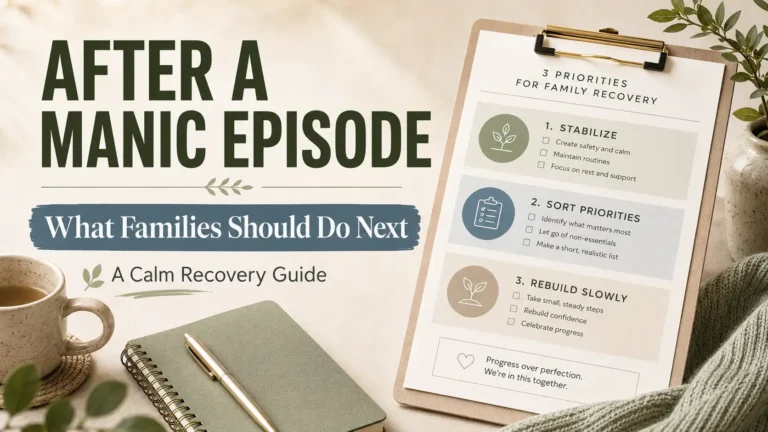
These scripts are for crisis moments. But the real repair happens when the episode ends.
When your partner is stable, say:
“I want to talk about what happened, but I do not want to blame you. I know that was the illness, not you. I also need you to know what I experienced, because we need to plan together for next time. Can we find a time this week to go over our crisis contract?”
This conversation is where boundaries are rebuilt, trust is restored, and prevention is planned. Do not skip it. The scripts above keep you safe during the storm. The morning-after conversation keeps you connected after it passes.
Frequently Asked Questions
Avoid: “calm down,” “you are manic,” “you are crazy,” “that is a terrible idea,” “you need help,” “you are being paranoid,” or any language that invalidates their emotional experience or directly contradicts their current reality. These phrases trigger shame, defensiveness, and escalation.
No. Mania impairs judgment, impulse control, and the ability to process contradictory information. Your goal is not to reason but to de-escalate, delay, and protect safety until professional treatment takes effect.
If there is violence or imminent threat of violence, prioritize immediate safety. Leave the space if possible. Call 911 or your local emergency number. Do not attempt to physically restrain unless you are trained. Verbal de-escalation scripts do not apply to violent situations — physical safety comes first.
You cannot “calm” a manic episode with words alone. Episodes require medical intervention — medication adjustment, sleep restoration, and sometimes hospitalization. What you can do is: reduce sensory input, avoid power struggles, use delay tactics, and contact their treatment team. Do not promise things you cannot deliver to calm them down.
Call 911 if: there is violence or threat of violence, your partner is attempting to harm themselves, they are driving while severely impaired, or you are unsafe and have no other exit. For non-violent but escalating episodes, contact their psychiatrist, a crisis line (988 in the US), or a mobile crisis team if available in your area.
Final Thought: You Are Not Failing When Scripts Fail
Some nights, you will say the calmest, most careful words you know, and the episode may still escalate. The next morning, you might replay the conversation and wish you had handled one sentence differently. And in the hardest moments, you may freeze, cry, say the wrong thing, or say nothing at all.
You are not failing. You are a human being trying to communicate with a brain that is temporarily hijacked by neurochemistry you did not cause and cannot control.
These scripts are training wheels. Eventually, you will develop your own language — the specific words that work for your specific partner, in your specific relationship, with your specific history. Until then, use these. Adapt them. Forgive yourself when they do not work. And remember: the goal is not to fix the episode. The goal is to survive it together.
I am Elena. I have used every script on this page. And I have also failed to use them when I was too tired, too scared, or too angry. Both are part of caregiving. Both are human.
Related Articles:
- Setting Boundaries with a Bipolar Loved One: A Caregiver’s 10-Step Framework
- How I (Elena) Learned to Say No Without Guilt: A Caregiver’s Story
- Caregiver Burnout: The Warning Signs I Ignored
- Resources for Bipolar Caregivers: Tools, Books & Support
Published: June 2026 | Author: Elena | Tags: Manic Episode, Communication, Caregiver Scripts, Crisis
Sources and Further Reading
For medical background, the National Institute of Mental Health explains bipolar disorder symptoms and treatment options, including how manic episodes can affect sleep, energy, judgment, and behavior.
Mania is not simply “being emotional” or “overreacting.” According to the National Institute of Mental Health, bipolar disorder can involve major changes in mood, energy, activity levels, concentration, and the ability to carry out daily tasks.
This is also why some caregiver resources recommend staying present without arguing and, when safe, walking with the person if they have a lot of energy. MyHealth Alberta’s guide on helping someone during a manic episode gives similar practical advice for staying calm, avoiding debate, and not taking hurtful comments personally.
For additional caregiver guidance, NAMI’s guidance on helping a loved one during a manic episode also emphasizes staying calm, avoiding confrontation, and seeking help when safety becomes a concern.
If you are in the U.S. and you are unsure where to start, the National Institute of Mental Health’s help page explains when to use 988, emergency services, and other mental health support options.