Arguing With Someone With Bipolar Disorder: How to De-Escalate Safely

You are already in the argument. Voices are rising, the same points keep coming back, and you are no longer sure whether continuing the conversation will solve anything or simply make it worse.
When someone you care about has bipolar disorder, it can also be difficult to know how much the diagnosis matters in that particular moment. Sometimes a conflict is simply a conflict. At other times, a difficult conversation may be happening alongside broader changes in sleep, energy, speech, activity, or behavior.
This guide focuses on one specific situation: what to do when a disagreement is actively escalating. It is not about avoiding every conflict or walking on eggshells. It is about slowing things down, deciding when to pause, setting limits you can actually enforce, and recognizing when the situation has moved beyond communication into safety.
Educational note: This article offers general information for families and caregivers. It cannot determine whether someone is experiencing a manic, depressive, mixed, or other mental health episode. A qualified professional must make that assessment.
Quick Answer: What Should You Do When an Argument Starts Escalating?
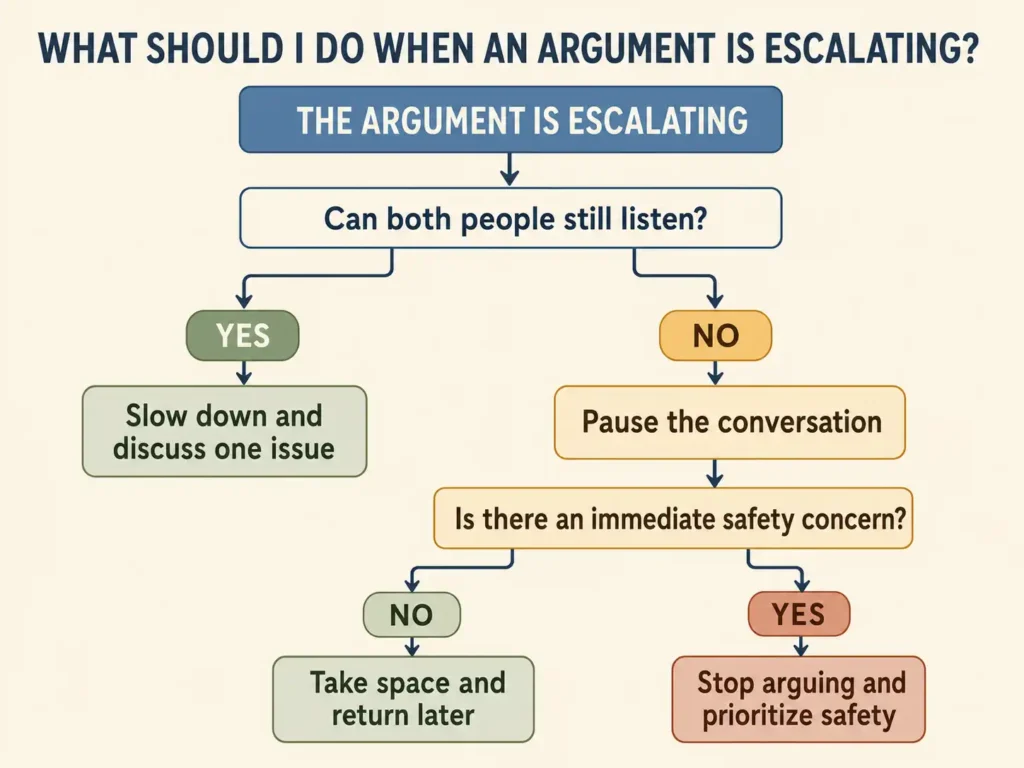
When an argument with someone who has bipolar disorder starts escalating, stop trying to win the disagreement. Lower your own volume and pace, keep your words short, avoid blaming the diagnosis, and decide whether either of you can still listen. If the conversation keeps getting hotter, pause it rather than forcing a resolution.
If there are threats, physical aggression, immediate danger, or a serious mental health crisis, stop treating the situation as an argument that needs to be solved. Focus on safety and appropriate crisis support instead.
Having bipolar disorder does not mean that every disagreement, angry reaction, or relationship problem is caused by a mood episode. The diagnosis also does not excuse threatening, abusive, or unsafe behavior.
First, Is This a Disagreement, an Escalating Argument, or a Safety Problem?
Before deciding what to say next, ask yourself what kind of situation you are actually dealing with.
| Situation | What It May Look Like | Best Next Step |
|---|---|---|
| Disagreement | Both people can still listen, disagree without threats, and stay focused on the issue. | Slow down and continue discussing one issue at a time. |
| Escalating argument | Voices are rising, interruptions increase, insults begin, or the same points keep repeating without progress. | Stop trying to solve everything and suggest a clear pause. |
| Safety concern | There are threats of harm, physical aggression, dangerous behavior, or severe mental health symptoms that create an immediate safety concern. | Prioritize safety and appropriate crisis or emergency support rather than continuing the argument. |
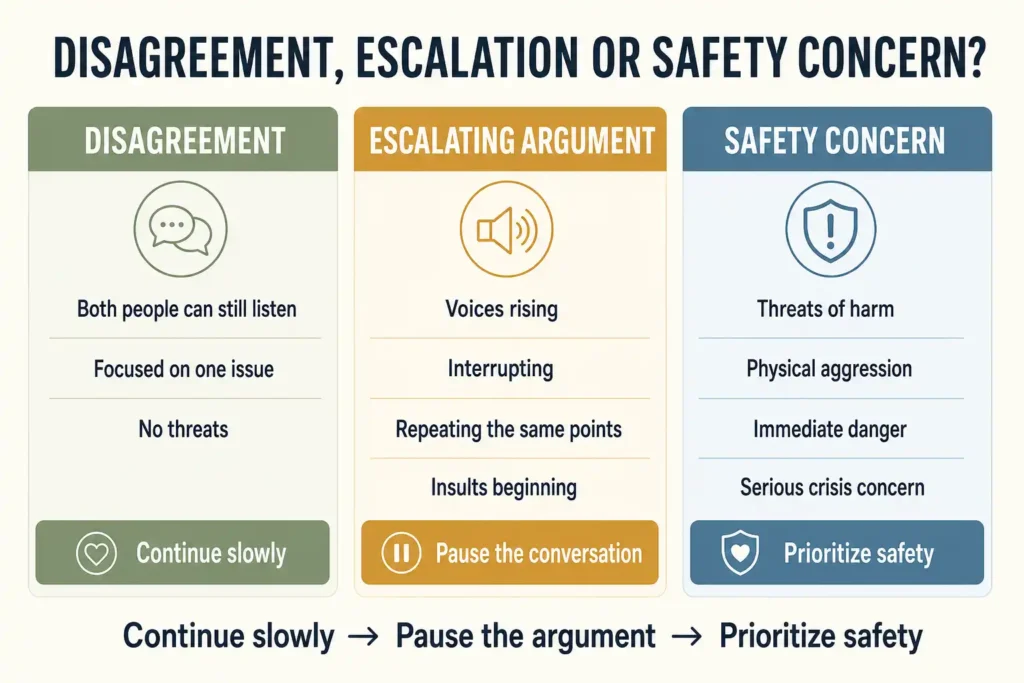
The goal is not to label the other person. It is to decide what you need to do next.
What to Do in the First Moments of an Escalating Argument
Lower your own intensity first
You cannot force another person to become calm, but you can avoid adding another layer of intensity. Lower your voice, slow your pace, and use fewer words.
Instead of delivering a long explanation, try:
“I want to hear you. I’m having trouble doing that while we’re both talking this fast.”
This is not surrendering your position. It is reducing one source of escalation so you can better judge whether the conversation is still productive.
Stop adding new arguments
When a conflict is already heated, avoid opening five more disagreements. Stay with the issue in front of you.
If the conversation has expanded from one problem to everything that has gone wrong over the past five years, say:
“There are several things here, and I don’t think we can solve all of them at once. Let’s stay with one issue.”
Use shorter sentences
Long explanations can easily become more material to debate when neither person is listening well.
Short does not have to mean cold:
“I hear that you’re upset.”
“I want to talk about this, but not like this.”
“We’re repeating ourselves. I think we need a break.”
For broader communication strategies outside an active argument, see our guide to communicating with someone who has bipolar disorder.
Decide whether the conversation can continue
Ask yourself one simple question:
Can either of us still hear anything the other person is saying?
If the answer is no, continuing may only create more material to repair later.
What to Say When You Want to De-Escalate the Argument
No sentence can guarantee that another person will calm down. These are examples you can adapt to your relationship and the situation.
When the conversation is speeding up
“I want to understand what you’re saying. Can we slow this down and take one thing at a time?”
When you are going in circles
“We keep repeating the same points. I don’t think continuing right now is helping either of us.”
When you need a break
“I’m going to take a break from this conversation. I’m not abandoning the issue. We can return to it when things are calmer.”
When the pause feels like rejection
“I still care about you. Taking a break is how I’m trying to stop this from becoming more hurtful.”
When you need to set a limit
“I’m willing to talk about this. I’m not willing to stay in a conversation where either of us is being insulted.”
More examples for difficult conversations are available in our guide to what to say when setting boundaries.
What Not to Say When the Conversation Is Already Heated
| Situation | Avoid | Try Instead |
|---|---|---|
| The tone is rising | “You’re being ridiculous.” | “I want to understand, but I don’t think we’re hearing each other right now.” |
| The conversation is looping | “I’ve already explained this ten times.” | “We’re repeating ourselves. I think we need a break.” |
| You need to pause | “I’m done with you.” | “I’m stepping away from this conversation for now. We can return to the issue when things are calmer.” |
| You suspect mood symptoms may be involved | “This is your bipolar talking.” | “Something about this conversation feels much more intense than usual.” |
| You need a boundary | “You need to stop yelling.” | “I’m willing to keep talking when we can speak without yelling.” |
For additional examples of language that can feel blaming or dismissive, read what not to say to someone with bipolar disorder.
When Bipolar Symptoms May Be Affecting the Conversation
Family members can observe patterns, but they cannot diagnose a mood episode from an argument alone.
If the conflict is happening alongside noticeable changes in sleep, energy, speech, activity, judgment, or behavior, it may be useful to consider the broader picture rather than treating the disagreement as an isolated event.
If the person appears unusually energized or irritable
Some manic or hypomanic episodes can involve unusually elevated or irritable mood, increased activity, rapid speech, racing thoughts, reduced need for sleep, or risky behavior. The exact pattern varies from person to person.
If you believe a manic episode may be part of the situation, avoid turning the argument itself into a debate about whether the person is manic. Instead, focus on what is happening right now and use the strategies in our guide on what to say during a manic episode.
If the person seems deeply depressed or overwhelmed
A heated debate may not be productive when someone is experiencing severe hopelessness, very low energy, or significant emotional distress. Keep communication simple, avoid pressuring them to solve everything immediately, and pay attention to any concerns about safety.
If reality testing or safety becomes a concern
Some people with bipolar disorder experience psychotic symptoms, such as hallucinations or delusions. Psychosis itself does not automatically mean that a person is dangerous. However, if severe confusion, psychosis, threats, or dangerous behavior creates an immediate safety concern, stop focusing on winning the disagreement.
Follow your existing bipolar emergency plan and seek appropriate professional, crisis, or emergency support.
When to Pause the Conversation Instead of Pushing for a Resolution
Consider pausing when:
- neither person is listening anymore;
- the same points are repeating without progress;
- voices continue to rise;
- insults or personal attacks have started;
- one or both of you are too overwhelmed to think clearly;
- you notice yourself saying things you are likely to regret;
- you feel intimidated, trapped, or unsafe.
A pause is not the same as pretending the problem does not exist.
You can say:
“This matters, and I want to come back to it. I don’t think we can solve it well right now.”
How to Take a Break Without Making It Feel Like Abandonment
Whenever it is safe and realistic, make the pause more specific.
Instead of:
“I’m not talking about this anymore.”
try:
“I’m going to take some space for the next hour. I’m willing to check in again after that and decide whether we’re both ready to talk.”
Do not promise an exact time if you do not believe you can safely or calmly return to the conversation then. A realistic boundary is better than a promise made simply to stop the argument.
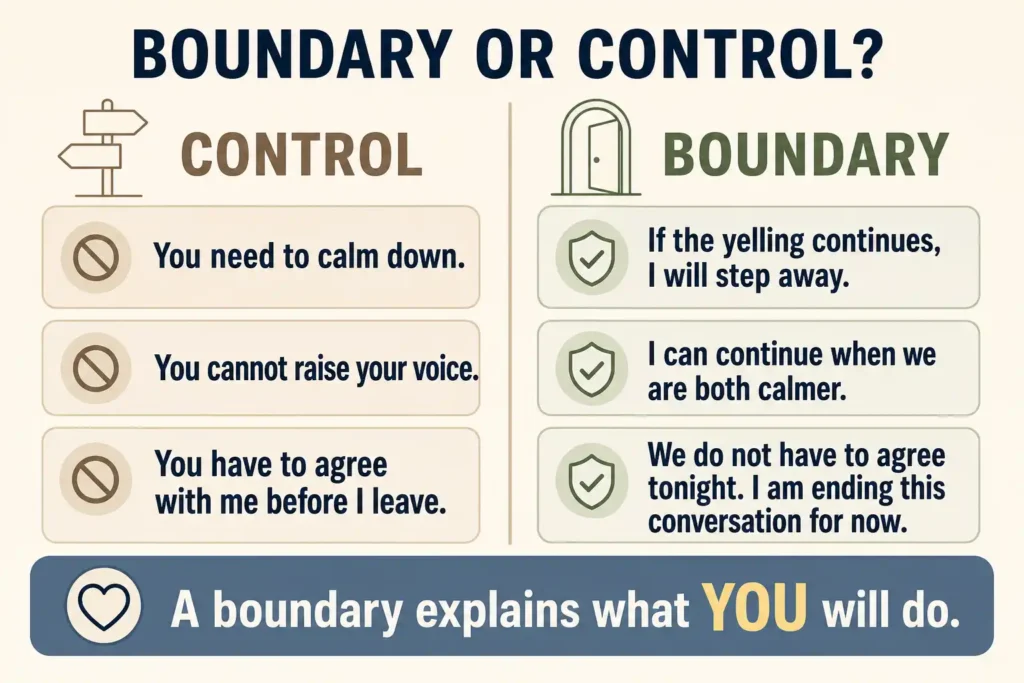
Boundary or Control? What Can You Actually Decide During a Conflict?
A boundary describes what you will do. Control attempts to dictate another adult’s feelings or behavior.
| Control | Boundary |
|---|---|
| “You are not allowed to raise your voice.” | “If the yelling continues, I will step away from the conversation.” |
| “You need to calm down right now.” | “I’m going to pause this conversation until we can both speak more calmly.” |
| “You have to agree with me before I leave.” | “We do not have to agree tonight. I am ending this conversation for now.” |
For a fuller framework, see setting boundaries with someone with bipolar disorder.
What If They Will Not Let the Argument End?
Sometimes you clearly say that you are ending the conversation, but the other person continues arguing.
If they keep following you from room to room
Do not turn the situation into a physical confrontation or try to restrain the person. Repeat your boundary briefly rather than adding new arguments.
“I’m not continuing this conversation right now.”
If you feel intimidated, trapped, or unsafe, focus on getting to a safer place and contacting appropriate support.
If the argument continues through calls or text messages
You are not required to answer every message immediately.
You might send one clear message:
“I’ve read your messages. I’m not continuing this conversation by text tonight. We can decide later when to talk again.”
Then stop re-arguing the same issue through dozens of messages.
If repeated contact becomes intimidating or unsafe
At that point, the question is no longer how to phrase the perfect response. Focus on safety, outside support, and the limits you need to protect yourself.
When an Argument Becomes a Safety or Crisis Situation
Safety note: If there are threats of harm, physical aggression, immediate danger, or a serious mental health crisis, prioritize safety over continuing the conversation.
In the United States, you can call or text 988, or use the 988 Lifeline chat, for mental health or suicide crisis support. A family member or friend who is worried about someone can also contact 988 for guidance.
If someone is in immediate physical danger or there is a life-threatening emergency, call 911 or your local emergency service.
Do not keep trying to resolve an argument once the situation has become an emergency.
How to Restart the Conversation After Both of You Are Calmer
The goal of the next conversation is not to replay every sentence that was said during the argument.
Start with one practical question:
“What would help us handle this differently next time?”
You can also say:
“Yesterday got more heated than I wanted. I still want to address the original issue, but I want us to do it differently.”
Focus first on the original problem. Then, if appropriate, discuss how the argument itself escalated.
This is also a good time to review whether either person crossed a boundary and what needs to change before the next difficult conversation.
How Families Can Reduce Repeated Conflict Over Time
Identify recurring conflict patterns
Notice whether the same arguments tend to happen at particular times, around the same subjects, or when everyone is already exhausted or overwhelmed.
You are looking for patterns you can plan around, not trying to diagnose symptoms.
Agree on a pause plan during calmer periods
It is easier to decide what a break should look like before the next argument begins.
You might agree on:
- a phrase either person can use to request a pause;
- where each person can take space;
- how you will decide when to revisit the issue;
- what happens if someone is concerned about safety.
Use the emergency plan when the issue is safety, not disagreement
A difficult conversation and a mental health crisis require different responses. Keeping an emergency plan available can help families avoid trying to invent a crisis response in the middle of a frightening moment.
Consider professional support for recurring conflict
If conflict is repeatedly damaging the relationship or household, professional support may help the family develop safer communication and problem-solving strategies.
You do not have to wait until every relationship is at a breaking point before asking for help.
A Quick Caregiver Self-Check After a Difficult Argument
- Do I feel physically safe right now?
- Did I stay longer in the argument than felt healthy or safe for me?
- Was a boundary crossed that needs to be addressed later?
- Am I taking responsibility for something that is not actually mine to control?
- Do I need sleep, food, quiet, or time before trying to solve anything else?
- Is this becoming a repeated pattern rather than an isolated disagreement?
- Do I need support for myself?
If these conflicts are leaving you constantly exhausted, fearful, or responsible for managing every emotional crisis, our guide to bipolar caregiver burnout may help you recognize when caregiving is taking too much from your own well-being.
Related Guides for Families
- How to Communicate With Someone Who Has Bipolar Disorder
- What to Say During a Manic Episode
- What Not to Say to Someone With Bipolar Disorder
- Setting Boundaries With Someone With Bipolar Disorder
- Bipolar Emergency Plan: A Family Guide
Trusted Resources
- National Institute of Mental Health: Bipolar Disorder
- National Institute of Mental Health: Bipolar Disorder Overview
- SAMHSA: 988 Frequently Asked Questions
- 988 Lifeline: Helping Someone Else
Frequently Asked Questions
Is it okay to argue with someone who has bipolar disorder?
People with bipolar disorder can disagree, discuss problems, and be held accountable like anyone else. The goal is not to avoid every disagreement. If the conversation becomes so heated that neither person can listen, pausing may be more productive than continuing to argue.
How do you de-escalate an argument with someone who has bipolar disorder?
Lower your own intensity, use shorter sentences, avoid bringing the diagnosis into the argument, stay with one issue, and consider pausing if the conversation is no longer productive. No technique can guarantee that another person will calm down.
What should you not say during a heated argument?
Avoid insults, sweeping statements such as “you always do this,” and comments such as “this is your bipolar talking.” Focus instead on the specific behavior or situation you are responding to.
Should I walk away from an argument?
Taking a break can be appropriate when the conversation is escalating or neither person can listen. When possible, clearly state that you are pausing the conversation rather than disappearing without explanation. If you feel unsafe, however, safety comes before completing that explanation.
How do I know if the argument is becoming a mental health crisis?
Look beyond the disagreement itself. Threats of harm, dangerous behavior, severe mental health symptoms that create a safety concern, or an inability to stay safe may require crisis or emergency support rather than continued discussion.
Does bipolar disorder cause anger and arguments?
Bipolar disorder does not explain every angry reaction or relationship conflict. Irritability can occur during some mood episodes, but people with bipolar disorder also have ordinary disagreements unrelated to an episode. Families can observe patterns and changes, but a professional assessment is needed to determine whether symptoms are part of a mood episode.
Final Takeaway
Arguing with someone who has bipolar disorder does not require finding the perfect words or avoiding every disagreement. In an escalating conflict, your most useful decisions are often simpler: lower your own intensity, stop adding new arguments, notice when neither person is listening, and be willing to pause.
You can care about someone and still end a conversation that has become harmful or unsafe. You can also return to an unresolved issue later without pretending that it never happened.
The goal is not to win every argument. It is to know when a conversation can still be repaired through communication, when it needs a pause, and when safety must come first.