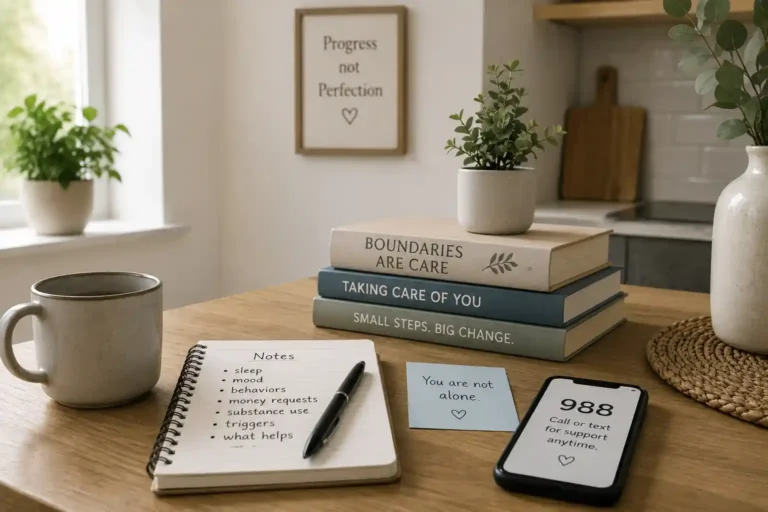
How I (Elena) Learned to Say No Without Guilt: A Caregiver’s Story

The Night I Realized “Yes” Was Killing Me
It was 2:47 AM on a Tuesday in March 2024. My partner was manic, pacing our living room, talking about starting a podcast that would “change the mental health landscape.” He needed $800 for equipment. He needed it tonight. And he needed me to believe in him.
Yes was the answer.
The money was transferred from our savings account — the account built for an emergency fund — and then the bathroom floor became my only support. Crying until my ribs hurt. Not because of the money. Because the certainty was absolute: yes would be the answer again tomorrow. And the day after. And the day after that.
Becoming a person who said yes to everything happened because no felt like abandonment.
This is the story of how that stopped. Not perfectly. Not completely. But enough to save myself, and — paradoxically — enough to save the relationship that was being protected by never saying no.
Quick Answer
How do you stop feeling guilty for setting boundaries with a bipolar partner?
Name your guilt. Most caregiver guilt falls into three categories: survival guilt (“I am healthy, they are not”), relationship guilt (“a good partner would endure this”), and identity guilt (“if I am not sacrificing, who am I?”). Reframe each: your health is not a resource you are withholding — it is a resource you are preserving. Saying no preserves the relationship, it does not abandon it. Start with one small no during a stable period. Use written scripts when guilt makes speaking impossible. Build an identity outside caregiving, one hour at a time. Guilt is information, not instruction.
If you need a broader step-by-step framework, start with this guide to setting boundaries with a bipolar loved one.
At a Glance: Breaking Free From Caregiver Guilt
| Type of Guilt | The Belief | The Reframe | First Step |
|---|---|---|---|
| Survival Guilt | “I am healthy and they are not, so I owe them everything” | “Your wellness is functional, not unfair” | Write one boundary just for you |
| Relationship Guilt | “If I say no, I am not committed” | “No redefines commitment from endurance to sustainability” | Say no to one small request during stability |
| Identity Guilt | “If I am not the sacrificer, who am I?” | “Caregiving is part of you, not all of you” | One hour/week doing something non-caregiver related |
In simple terms: caregiver guilt often sounds like “I owe them everything,” “a good partner would endure this,” or “I do not exist outside this role.” Healing starts when you name which guilt voice is speaking.
- Week 1: Name your guilt type + write one non-negotiable
- Month 1: Practice one script per week
- Month 3: Guilt decreases significantly with consistent boundary-holding
- Month 6: Guilt becomes background noise, not a command
Key metric: Can you say no without your hands shaking? That’s progress.
What Caregiver Guilt Actually Is (And Why It Is So Powerful)
Caregiver guilt is not a character flaw. It is a biological and social response to a specific set of conditions. When someone you love is suffering, your brain releases cortisol and oxytocin in competing waves — the stress of their pain, the bonding urge to fix it. Over time, this cocktail trains your nervous system to equate “helping” with “safety” and “refusing to help” with “danger.”
What the research says:
A 2021 study in the Journal of Affective Disorders found that caregivers of individuals with bipolar disorder reported guilt levels significantly higher than caregivers of people with physical chronic illnesses. The researchers hypothesized that the unpredictable nature of mood episodes — the sense that “this crisis might have been preventable” — created a unique form of self-blame that physical illness caregivers did not experience.
What that meant:
Every episode triggered the same whisper: “If you had been more patient, more available, more understanding, this wouldn’t have happened.” Every consideration of saying no — to a late-night conversation, to a financial request, to canceling my own plans — produced guilt that was not just emotional. It was physical. Chest tightening. Throat closing. Hands shaking.
That was not weakness. It was conditioning.
The Three Types of Guilt I Had to Name
Before no became possible, understanding what was actually being felt became essential. Three distinct flavors of guilt emerged, each requiring a different response.
1. Survival Guilt
The belief:“I am healthy and they are not. Therefore I owe them every resource I have.”
This was the default setting. My partner had bipolar disorder. I did not. He struggled to sleep, to work, to maintain relationships. Sleeping fine, working fine, having friends — the imbalance felt morally wrong. Saying no felt like hoarding privilege.
The reframe: My therapist said something that cracked this open: “Your health is not a resource you are withholding. It is a resource you are preserving. A sick caregiver cannot care for a sick partner. Your wellness is not unfair — it is functional.”
2. Relationship Guilt
The belief:“If I say no, I am proving I am not committed. A good partner would endure this.”
This guilt came from the stories absorbed about love — that real love is unconditional, that marriage means “in sickness and in health,” that leaving the room during a fight is giving up.
The reframe: The question became: “What kind of relationship am I actually building?” A relationship where one person never says no is not love. It is enmeshment. Two people fused so tightly that neither can breathe. Saying no was not a withdrawal of commitment. It was a redefinition — from “I will endure anything” to “I will show up sustainably.”
3. Identity Guilt
The belief:“If I am not the person who sacrifices everything, who am I?”
This was the deepest and most frightening. Caregiving had become my identity. Friends knew me as “the one with the bipolar partner.” Family checked in about him, not me. Social media — when still used — was full of mental health advocacy posts. Stopping yes meant fearing disappearance.
The reframe: Rebuilding an identity outside caregiving happened piece by piece. It started with one hour a week — one hour where medication, mood, and sleep were not thought about. A yoga class. No posting about it. Just existing as a person with a body that needed stretching. It felt like betrayal. It also felt like remembering.
The First No: What It Actually Looked Like
The first real no was not dramatic. It was small, and that is why it mattered.
A Saturday afternoon. My partner was stable — medicated, sleeping, working part-time. Dinner with my sister was planned. He asked me to cancel so we could watch a movie together. Not in crisis. Not manic. Just wanting company.
Every fiber said yes. My sister would understand. We could reschedule. He had been so good lately. Didn’t he deserve attention?
Instead: “I love that you want to spend time together. I am going to dinner with my sister tonight. Can we watch the movie tomorrow?”
Disappointment followed. Not anger. Not hurt in the catastrophic way imagined. Just disappointment. And survival happened. Heart rate elevated for maybe ten minutes. Then normalization. Dinner happened. Laughing with my sister happened. The movie happened on Sunday.
That one no taught more than any article ever could. No does not have to be a wall. It can be a door that opens later.
The Scripts I Used When Guilt Made Speaking Impossible
In the beginning, trusting my own voice was impossible. Guilt softened nos until they became yeses. So scripts were written. Read verbatim. Kept in my phone and pulled out when my throat closed.
When I needed to keep my own plans:
“I know you want me to stay. I also know that I need this time with my friend/sister/therapist to be the partner you need long-term. I am leaving now. I will be back at [time]. I love you.”
Keeping my own plans:
“I am not comfortable lending money right now. This is not about whether I love you or believe in you. It is about protecting our financial stability. Let’s talk about this again when you have slept eight hours for three nights in a row.”
Leaving an escalating conversation:
“I am not going to stay in this conversation while voices are raised. I am going to the bedroom. When you are ready to talk without yelling, I am ready to listen. I am not leaving you. I am leaving this specific moment.”
Stepping back from medication management:
“I love you, and I cannot manage your medication compliance for both of us. If you choose not to take your medication, I will need to step back from managing the consequences. I will support your treatment, but I cannot substitute for it.”
These scripts saved me because they removed improvisation. When guilt is active, your prefrontal cortex is compromised. Language already written by your stable self becomes essential.
What Happened When I Started Saying No
The first month was chaos. Not because my partner fell apart — because I did.
Five nos. Panic after each one. Texting my therapist at midnight. Calling my sister crying. Checking my partner’s breathing while he slept, terrified that no had damaged him irreparably.
Then something unexpected happened.
He started respecting my boundaries. Not perfectly. Not consistently. But more than before. Stopping the collapse of every boundary taught him that my words had weight. Leaving the room during yelling made the yelling stop faster. Refusing financial requests during episodes made him start calling his psychiatrist instead of me.
Our relationship became more honest. No longer pretending to be okay with things that destroyed me meant actual conversations about what was happening. He could sense resentment dissolving. Shame decreased — because watching me sacrifice myself and feeling guilty about my guilt stopped.
Sleeping through the night started happening. Not every night. But most. And sleep changed everything. Anxiety decreased. Patience increased. The ability to show up authentically — rather than performatively — returned.
The Guilt That Never Fully Disappears
Honesty matters here. Two years in, guilt still happens sometimes. Last month, a depressive episode made my partner ask me to stay home from a work event. No was the answer. The event was attended. My phone was checked every twelve minutes. Guilt was felt the entire time.
But here is what changed: the guilt no longer controls behavior. It is a feeling noticed, acknowledged, and moved through. No longer a command.
Guilt is information, not instruction. It tells you that you care. It does not tell you what to do.
What I Would Tell the Elena of March 2024
If sitting with the woman crying on her bathroom floor at 2:47 AM were possible, this is what would be said:
Preserving yourself is not abandonment. Having limits does not make you a bad partner. Needing sleep, money, friends, or a life that is not entirely about his illness does not make you selfish.
The $800 will not stop the episode already building. It will not prove love either. All it will do is deepen the hole you are both standing in.
Say no. Not cruelly. Not permanently. But clearly. And then go to bed. Because the most loving thing you can do tomorrow is show up as a person who is still whole.
If You Are Struggling to Say No
If your throat tightens at the thought of refusing a request, know that this is a skill, not a trait. It can be learned. I did.
Three starting points:
- Write one non-negotiable. Just one. Not five. One thing you will not do this week, no matter what. Write it down. Put it on your mirror. Practice saying it out loud in the shower.
- Find one person who knows. Tell one friend, one family member, or one therapist that you are trying to set boundaries and need someone to remind you that guilt is not a stop sign. Mine was found in an online therapy session that was almost canceled.
- Read one resource that reframes guilt. The book Boundaries by Cloud and Townsend is not about bipolar disorder, but it is about the theology of no — and it gave permission I did not know I needed.
If drowning in caregiver guilt and not knowing where to start, talking to a therapist who understands the dynamics of mental illness caregiving can be transformative. BetterHelp was where I started because sessions could be scheduled around unpredictable crises, and because someone was needed who would not say “just leave him.” Someone who would help me stay without disappearing.
Affiliate Note: The books that rebuilt my framework:
- Loving Someone with Bipolar Disorder: Understanding and Helping Your Partner by Julie A. Fast — practical, non-judgmental, written for partners
- Boundaries Updated and Expanded Edition: When to Say Yes, How to Say No To Take Control of Your Life by Cloud and Townsend
- Essential for anyone who confuses love with self-abandonment. See our full caregiver resource list →
Frequently Asked Questions
Yes. Caregiver guilt is documented at significantly higher rates in bipolar caregiving than in physical illness caregiving, largely due to the unpredictable nature of mood episodes and the cultural narrative that love should be unconditional. Feeling guilty does not mean your boundary is wrong. It means you care.
You cannot control whether your no triggers an episode. What you can control is how you deliver it: calmly, without blame, using “I” statements, and during stable periods when possible. If your partner becomes unsafe after a boundary, that is a medical issue, not a relationship failure. Contact their treatment team or crisis services.
This is a common manipulation tactic — sometimes intentional, sometimes driven by fear of abandonment during mood instability. The response that worked for me: “I love you, and that is exactly why I am setting this boundary. I need to protect myself so I can keep loving you sustainably.” Repeat as needed. Do not debate the boundary itself.
Final Thought: No Is a Complete Sentence
Every no used to require a paragraph of explanation, a list of justifications, and a promise that it would be made up later. That was wrong.
No is a complete sentence. It can be softened with love — “No, I cannot do that tonight. I love you.” — but it does not require a dissertation. Your needs do not need to be proven in court. They need to be stated, held, and respected.
You are allowed to say no. You are allowed to need things. You are allowed to be a person who exists outside of caregiving.
I am Elena. Still learning to say no. But no longer afraid of the word.
Related Articles:
- Setting Boundaries with a Bipolar Loved One: A Caregiver’s 10-Step Framework
- Caregiver Burnout: The Warning Signs I Ignored
- What to Say During a Manic Episode: 7 Scripts That Work
- My Story as Elena: Caring for Someone with Bipolar
Published: June 2026 | Author: Elena | Tags: Caregiver Guilt, Boundaries, Bipolar Relationships, Self-Care, Personal Story
If you are in the U.S. and someone may harm themselves or someone else, call or text 988 for crisis support, or call emergency services if there is immediate danger. If you are outside the U.S., use your local emergency number or a local crisis line.
Important: This article is a personal caregiving story and is not medical, psychiatric, legal, or financial advice. If your partner is at risk of harming themselves or someone else, or if you feel unsafe, contact emergency services or a crisis line immediately. For treatment decisions, medication questions, or crisis planning, speak with a licensed mental health professional.
For general information about bipolar disorder, symptoms, and treatment options, the National Institute of Mental Health offers a helpful overview.