What to Say to Someone With Bipolar Depression
When someone you care about lives with bipolar disorder and appears to be struggling with depression, it can be difficult to know what to say. You may notice less energy, fewer replies, withdrawal, or language that sounds hopeless. Those signs can have different meanings, and they do not allow a family member to diagnose an episode.
There is no single phrase that works for everyone, and supportive words cannot treat bipolar depression. They can still communicate care, reduce unnecessary pressure, offer practical help, and create an opening for additional support.
This article provides general educational guidance. It does not replace professional assessment, treatment, or crisis support. When there is a genuine concern about suicide or immediate safety, safety takes priority over finding the perfect words.
Quick Answer: What Should You Say to Someone With Bipolar Depression?
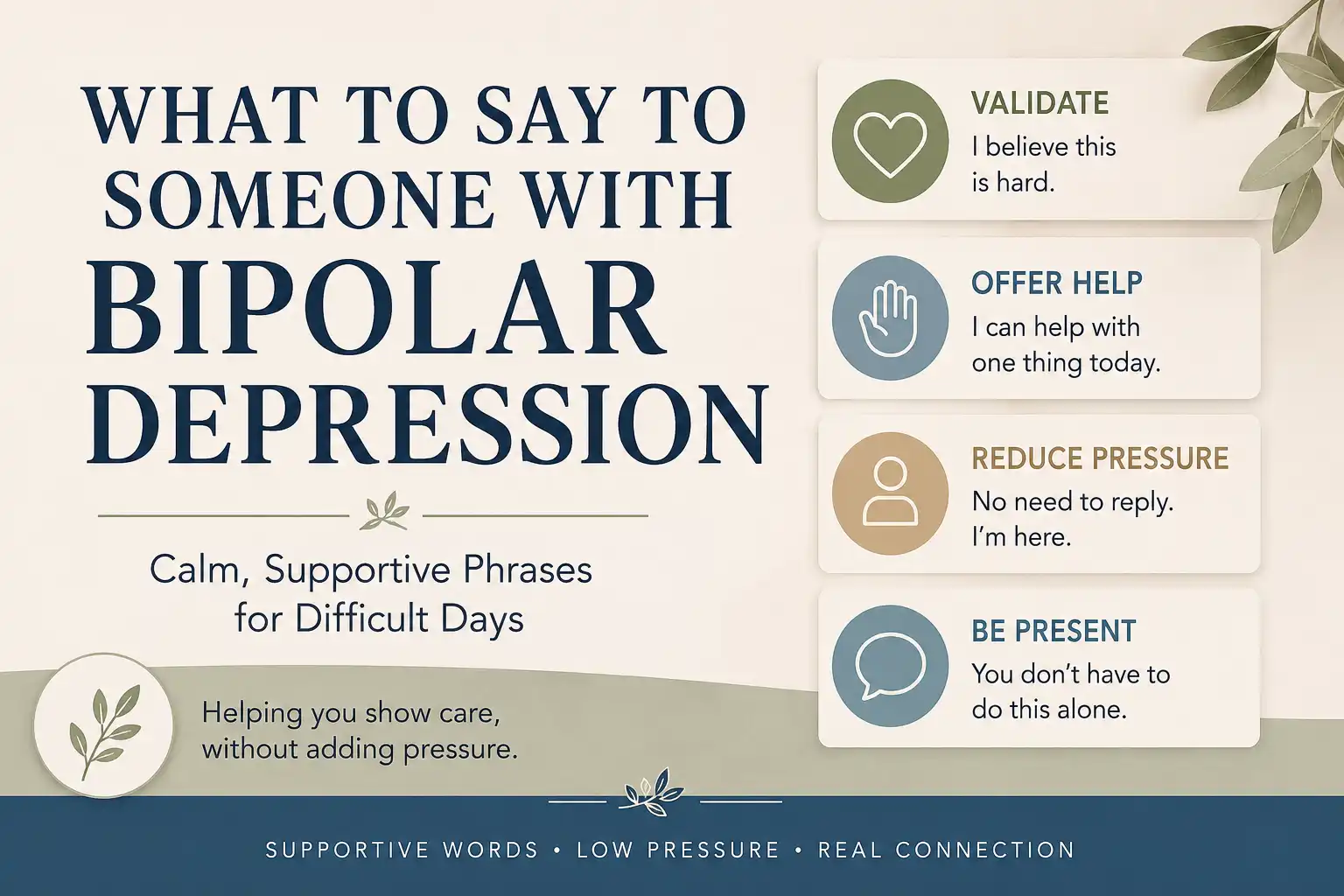
Keep your words simple, respectful, and realistic. Acknowledge that the person appears to be having a difficult time without claiming that you fully understand their experience. Offer quiet presence or one specific form of practical help, and avoid demanding an immediate reply. You might say, “You do not have to explain everything. I care about you, and I can help with one small thing today.” Do not try to talk the person out of depression or manage treatment yourself. If something they say makes you concerned about suicide, ask directly and calmly whether they are thinking about suicide, then involve appropriate crisis support rather than handling the situation alone.
What Supportive Words Can and Cannot Do
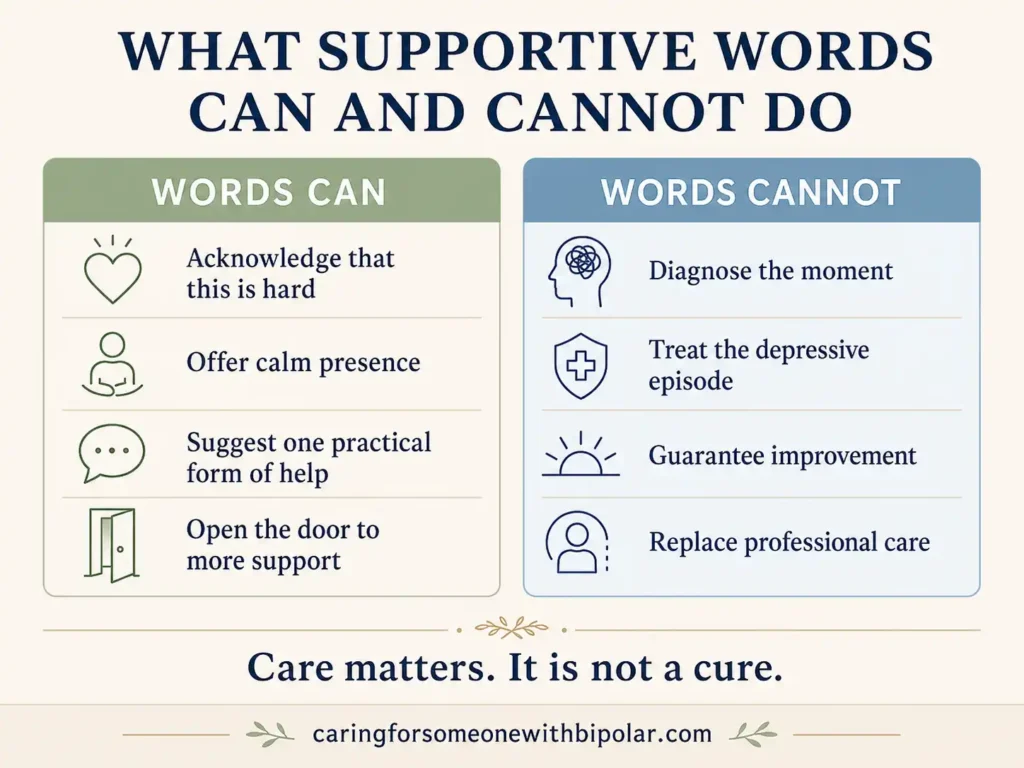
Your words can help preserve connection
A short, calm message can communicate that the person does not have to pretend to be okay or explain everything before receiving care.
The person may not respond immediately. A lack of response does not tell you whether the message was helpful, whether they want space, or whether they need more support.
Your words cannot treat or end the episode
Supportive language is not a treatment. It cannot guarantee that symptoms will improve, and it should not replace contact with a qualified mental health professional or an existing care team.
You do not have to become the person’s therapist, treatment manager, or only source of support.
You do not need a perfect sentence
Trying to produce flawless wording can make you hesitate or overexplain. A brief and honest sentence is often easier to receive than a long speech filled with advice.
You can acknowledge your uncertainty:
“I do not have the perfect words, but I care about you.”
Support should not depend on an immediate response
Someone who is struggling may have limited energy for conversation, decisions, or messages. You can reduce pressure by saying when you will check in again and making it clear that an immediate reply is not required.
Your words are not a cure. They can still communicate dignity, care, and a willingness to help.
For broader communication guidance outside a depressive period, read how to communicate with someone who has bipolar disorder.
15 Supportive Things to Say During Bipolar Depression
These phrases are starting points. Adapt them to your relationship, your actual availability, and what the person has previously said feels helpful.
Phrases that validate without pretending to understand
- “I may not fully understand what this feels like, but I believe that it is hard.”
- “You do not have to convince me that you are struggling.”
- “I am sorry this feels so heavy right now.”
- “You do not need to act okay for me.”
Phrases that offer presence without pressure
- “You do not have to explain everything. I can stay with you quietly.”
- “Would you prefer company, a short conversation, or some space?”
- “You do not need to reply right away. I will check in tomorrow.”
- “I do not have the perfect words, but I care about you.”
Phrases that offer practical help
- “I can bring dinner or handle one errand. Which would help more?”
- “Would it help if I sat with you while you made that call?”
- “We can choose one small thing for today.”
- “I can help with this specific task. You do not have to solve everything today.”
Phrases that open the door to additional support
- “Would you like help contacting someone on your care team?”
- “I care about you, and I think this may need more support than I can provide alone.”
- “Would you like me to stay while you call or text for support?”
None of these phrases is guaranteed to produce a particular response. Do not repeat a script in order to pressure the person into talking, accepting help, or reassuring you.
What to Say When They Feel Like a Burden
If the person tells you that they feel like a burden or a problem, avoid immediately arguing with them or making promises you cannot maintain.
You can acknowledge the feeling while offering honest support:
- “You matter to me. You do not have to earn my care by feeling better.”
- “Needing help does not make you a problem.”
- “You do not have to apologize for struggling.”
- “I can help with this one thing today.”
- “I care about you, and I want us to have enough support for both of us.”
Absolute promises such as “I will always take care of everything” or “I will never leave you” may not be realistic. A more sustainable response describes what you can genuinely offer now.
For example:
“I can stay with you for the next hour. After that, I want to help you connect with someone else who can also support you.”
What to Say When They Do Not Want to Talk
Silence by itself does not tell you whether the person wants space, has limited energy, is upset with you, or needs additional support. Avoid repeatedly demanding an explanation.
You can make the next step easier and more predictable:
- “You do not have to talk. I can sit here quietly.”
- “I will give you some space and check in at 7.”
- “You can answer with one word or an emoji if that feels easier.”
- “I am here. No explanation is required.”
- “Would you prefer that I text again tomorrow?”
Respecting space does not have to mean disappearing without explanation. A planned check-in can communicate care without creating constant pressure.
If you have a specific reason to worry about safety, address that concern directly instead of relying only on low-pressure messages.
What to Text Someone With Bipolar Depression
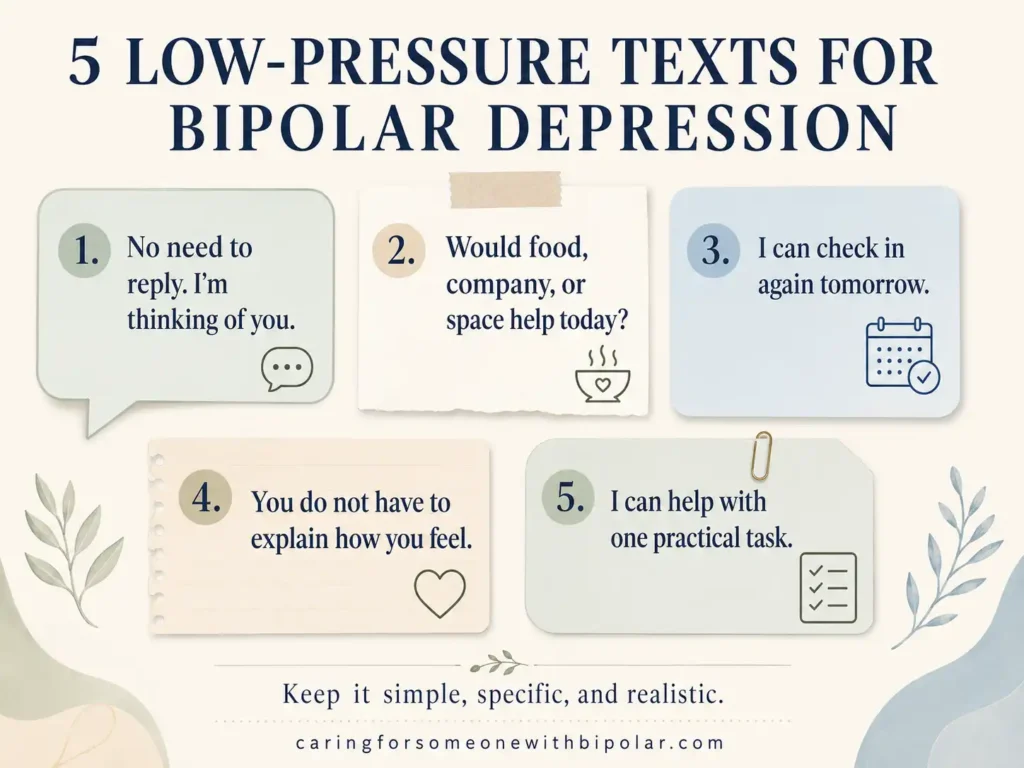
A short text may be easier to read than a long message that contains multiple questions or requires a detailed response.
- “No need to reply. I’m thinking of you.”
- “Would food, company, or space help today?”
- “I can check in again tomorrow.”
- “You do not have to explain how you feel.”
- “I can help with one practical task today.”
When you have a genuine safety concern, use direct language rather than a vague check-in:
“I’m concerned about your safety. Can you tell me if you are safe right now?”
That final message is not intended for every unanswered text. It belongs in a situation where something the person said or did has given you a specific reason to worry.
How to Offer Help Without Creating More Pressure
Offer one or two specific choices
A broad statement such as “Let me know if you need anything” asks the person to identify a need, make a decision, and organize the request.
A specific offer may be easier to consider:
“I can bring a meal or pick up groceries. Would either help?”
This is a practical option, not a guaranteed method. Some people may prefer no practical help at that moment.
Avoid asking them to organize the entire solution
Try not to present a long list of appointments, errands, household tasks, and treatment decisions at once.
Choose one manageable question:
“Would it help if I handled dinner tonight?”
Ask permission before giving advice
Advice can feel overwhelming when it arrives before the person has asked for it.
You might say:
“Would you like me to listen, help you think through an option, or simply stay with you?”
Accept a no when safety is not at stake
If the person declines a meal, company, an errand, or a conversation, you do not have to keep persuading them.
You can respond:
“Okay. I will respect that. I can check in again tomorrow unless you would prefer something different.”
Follow up without demanding reassurance
A caregiver may send a message partly because they are frightened and need confirmation that everything is okay. Try not to make the person responsible for immediately reducing your anxiety.
Keep the follow-up short and clear:
“No detailed reply is needed. I wanted you to know I am thinking of you.”
What Not to Say During Bipolar Depression
This section is intentionally focused. For a broader discussion, read what not to say to someone with bipolar disorder.
| Avoid Saying | Try Saying Instead | Why |
|---|---|---|
| “Just think positive.” | “I know this feels heavy. I am here.” | It avoids forced optimism. |
| “Everyone feels sad sometimes.” | “I may not understand fully, but I believe you.” | It does not minimize the experience. |
| “You were fine yesterday.” | “I have noticed today seems harder.” | It focuses on the present without accusation. |
| “Are you taking your medication?” | “Would you like help reaching a healthcare professional or someone on your care team?” | It offers support without turning the conversation into medication monitoring. |
| “You need to get out of bed.” | “Would one small task feel possible today?” | It offers a choice rather than a command. |
| “Everything will be okay.” | “You do not have to face this moment without support.” | It offers realistic support without predicting the outcome. |
How to Mention Professional Support Without Sounding Controlling
You can encourage professional support without acting as a clinician or supervising the person’s treatment.
Ask permission and offer practical assistance:
- “Would it help to contact someone on your care team?”
- “Would you like me to sit with you while you make the call?”
- “I am worried, and I think we need more support than I can provide alone.”
- “I cannot make this decision for you, but I can help you look at the options.”
Avoid telling the person that they need a particular medication, a different medication, or a specific form of treatment. Do not present yourself as able to determine whether their treatment is working.
If the person consistently declines help, the guide on what to do when someone with bipolar disorder refuses help provides a more complete framework.
What to Say If You Are Worried About Suicide
Not every conversation about depression is a suicide crisis. However, statements about suicide, a plan to hurt oneself, or having no reason to live should not be dismissed.
If something the person says makes you concerned, ask directly and calmly:
“I’m worried about what you said. Are you thinking about suicide?”
Listen without judging, lecturing, or debating whether the person should feel that way. Do not promise to keep a suicide plan secret.
In the United States and its territories, call or text 988 or use the 988 online chat for mental health or suicide crisis support. A concerned family member or friend may also contact 988 about another person.
If there is immediate physical danger or an urgent medical emergency, call 911.
For advance planning during a calmer period, see the bipolar emergency plan.
What If They Say Hurtful Things to You?
A depressive period does not require you to accept insults, threats, coercion, or unsafe behavior. It is also not accurate to assume that every difficult response is caused by bipolar depression.
You can acknowledge the person’s distress while maintaining a limit:
- “I care about you, but I will not continue while I am being insulted.”
- “I am going to pause now and check in later.”
- “I can listen, but I cannot be your only source of support.”
- “I want to help, and I also need us to speak respectfully.”
Do not use the diagnosis as an accusation. Focus on the behavior and what you will do next.
For more adaptable scripts, read what to say when setting boundaries.
How to Support Them Beyond Words
Support may include quiet presence or one practical action rather than a long conversation.
Depending on the relationship and what the person wants, you might offer to:
- Bring a meal
- Handle one errand
- Provide transportation that they have requested
- Sit nearby without requiring conversation
- Help prepare a question for an appointment
- Agree on a specific time for the next check-in
- Help contact an existing source of professional support
Do not take over medication decisions, impose a routine, monitor the person constantly, or promise that a particular activity will improve the episode.
For help distinguishing support from taking control, read how to support someone with bipolar disorder without enabling.
Protect Your Own Capacity Too
You cannot be available every hour or become another person’s complete treatment and crisis system. Honest availability is usually more sustainable than an unlimited promise.
You might say:
“I can stay for 30 minutes. Then I need to rest, and I want to help you connect with someone else who can support you too.”
Whenever possible, involve additional trusted relatives, friends, peer support, professionals, or crisis resources rather than carrying the entire situation alone.
Your own exhaustion, fear, anger, or need for rest also deserves attention. The guide on bipolar caregiver burnout can help you assess the pressure you are carrying.
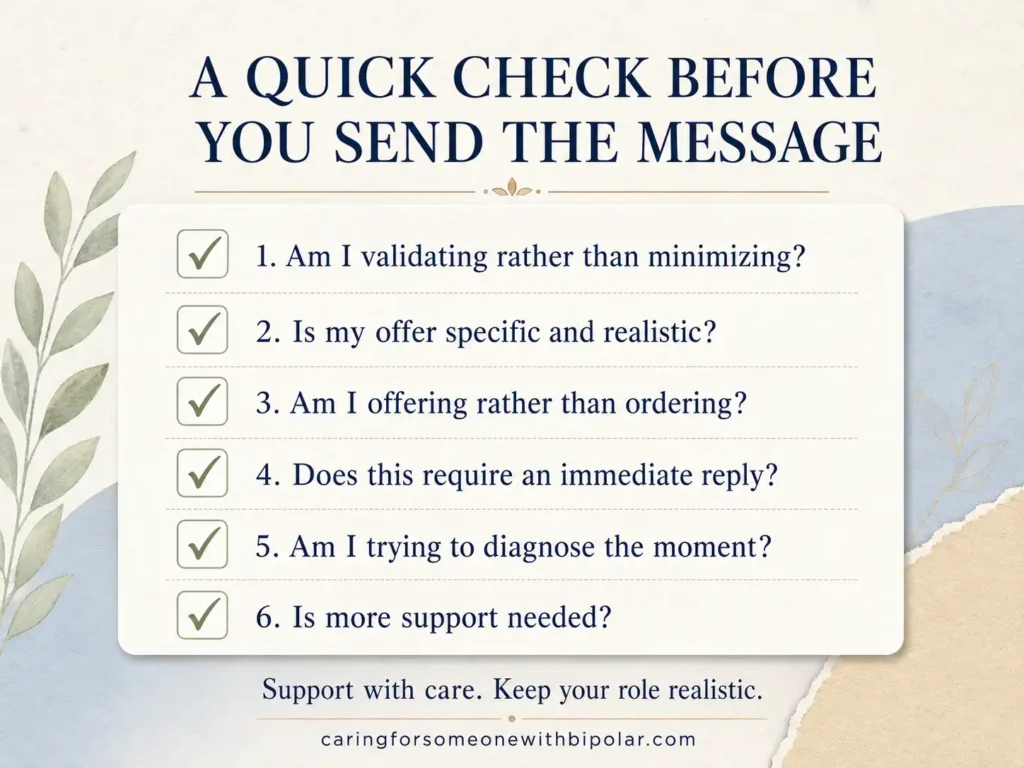
A Quick Check Before You Send the Message
This checklist is an organizational tool for reflection, not clinical guidance.
- Am I validating rather than minimizing?
- Am I offering support rather than giving orders?
- Is my offer specific and realistic?
- Am I asking for a response that may require too much energy?
- Am I making a promise I cannot keep?
- Am I trying to diagnose the moment?
- Is this ordinary support, a concerning statement, or a safety crisis?
- Do I need help from another person or resource too?
Trusted Resources
- National Institute of Mental Health: Bipolar Disorder
- National Institute of Mental Health: Depression
- NAMI: Family Members and Caregivers
- DBSA: For Friends and Family
- 988 Suicide & Crisis Lifeline: Help Someone Else
- SAMHSA: 988 Frequently Asked Questions
Frequently Asked Questions
What do you say to someone going through bipolar depression?
Acknowledge that they appear to be struggling, avoid claiming that you know exactly how they feel, and offer one realistic form of help. For example: “You do not have to explain everything. I care about you, and I can help with one small thing today.”
What should I text someone with bipolar depression?
Keep the message brief and remove pressure to answer immediately. You might write: “No need to reply. I’m thinking of you, and I can check in again tomorrow.”
What should I avoid saying to a depressed person?
Avoid minimizing statements, forced positivity, treatment instructions, and promises that everything will be fine. Focus on acknowledging the current difficulty and offering realistic support.
How do I help if they do not want to talk?
Respect the person’s choice while explaining what you will do next. You might say: “You do not have to talk. I will give you some space and check in again this evening.” Address safety directly when there is a specific reason for concern.
What should I say if I am worried they may be suicidal?
Ask directly and calmly: “Are you thinking about suicide?” Do not promise secrecy. In the United States and its territories, call or text 988 or use 988 chat for crisis support. Call 911 if there is immediate physical danger or an urgent medical emergency.
Final Takeaway
You do not need a perfect sentence. Aim for words that reduce pressure, respect the person’s dignity, offer one realistic form of help, and recognize when more support is needed.
You can be compassionate without becoming the person’s therapist, treatment manager, or only source of safety. Honest care, clear limits, and appropriate outside support can exist together.