
How to Cope With a Bipolar Parent as an Adult

Having a parent who lives with bipolar disorder can bring up love, anger, loyalty, fear, grief, guilt, and responsibility at the same time. You may care deeply about your parent while also feeling tired, hurt, uncertain, or protective of the life you have built as an adult.
There is no single experience of being the adult child of a parent with bipolar disorder. Some relationships remain close and supportive. Others require more structure, firmer boundaries, or distance. The diagnosis may provide context for some experiences, but it does not explain every family conflict or erase the impact of harmful behavior.
This guide offers general educational support. It does not diagnose your parent, interpret past events, replace professional mental health care, or provide legal or financial advice.
Quick Answer: How Do You Cope With a Bipolar Parent as an Adult?
Start by separating what you can control from what you cannot. You can choose your words, boundaries, level of contact, and the help you freely offer. You cannot control your parent’s mood, treatment decisions, choices, or recovery. Decide what contact is safe and sustainable, state limits in terms of what you will do, and avoid becoming the only person responsible during a crisis. You can care about your parent without managing every consequence of their illness. Support for yourself, through trusted people, peer groups, or a qualified professional, can also help you protect your wellbeing and maintain a life outside the family caregiving role.
Why Can This Relationship Still Feel So Complicated in Adulthood?
Becoming an adult does not automatically remove the emotional patterns of a parent-child relationship. Calls, visits, requests, and disagreements may still bring back familiar feelings or expectations.
Periods of significant symptoms can also make communication or everyday responsibilities more difficult in some families. At the same time, not every disagreement, disappointment, or difficult behavior is caused by bipolar disorder.
You may still feel like the child in the relationship
Even when you are financially independent and living separately, you may feel pulled back into an earlier family role. A request for help, an intense call, or a sudden problem can make you feel that you must immediately calm the situation or find the solution.
Noticing that reaction does not mean you are failing your parent. It gives you a chance to decide whether the responsibility truly belongs to you.
Old family patterns can continue into adult life
Some families develop patterns in which one person repeatedly explains, rescues, mediates, or absorbs the stress. Those roles may continue simply because everyone is used to them.
You can reconsider a long-standing role without denying that your parent may sometimes need support. The aim is not to stop caring. It is to make your involvement more deliberate and sustainable.
Love, anger, grief, and loyalty can coexist
You may love your parent and still feel angry about something that happened. You may feel protective one day and resentful the next. You may grieve the relationship you hoped to have while valuing parts of the relationship that remain meaningful.
Mixed feelings do not make you disloyal. They reflect the fact that family relationships can contain more than one truth at a time.
Family roles may be difficult to change
Your parent may expect you to answer every call, provide money, make decisions, forgive quickly, or manage a problem. You may also expect those things from yourself because they have become familiar.
Changing that pattern may feel uncomfortable. Clearer roles can nevertheless make the relationship more manageable and reduce confusion about what you are willing to do.
What Is Your Responsibility, and What Is Not?
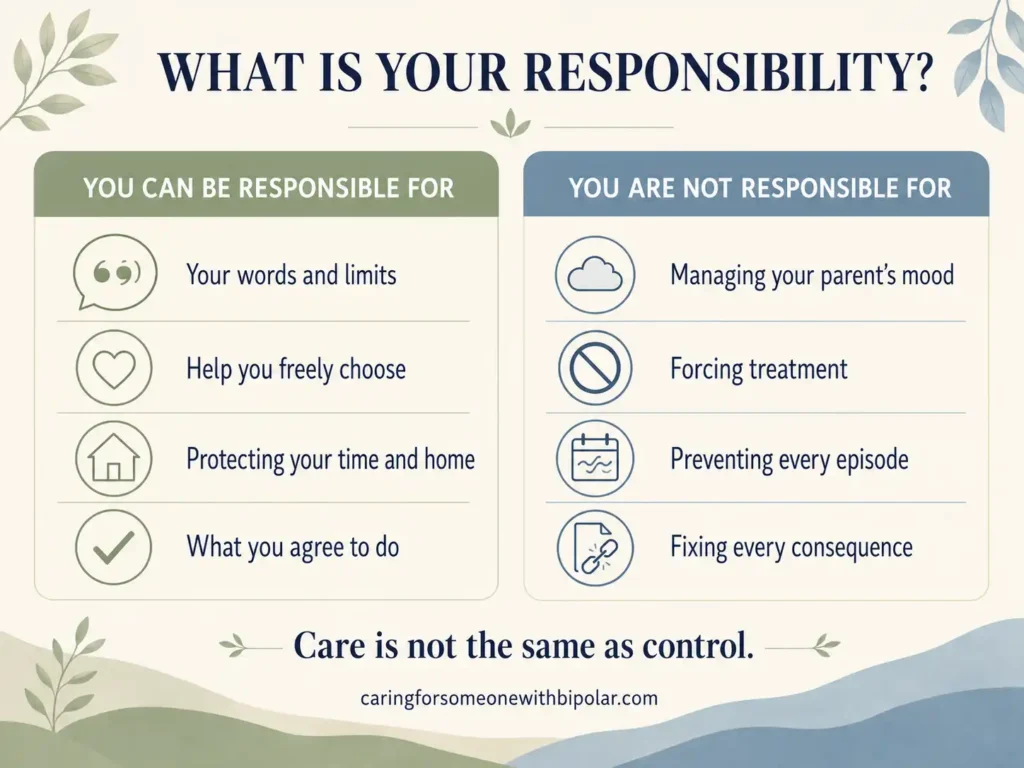
You are responsible for your own actions, choices, and limits. You can decide what support you are able to offer and what you cannot safely or sustainably take on.
You are not responsible for managing another adult’s health condition, making them accept treatment, preventing every mood episode, or repairing every consequence. For a deeper explanation of the difference between support and taking over, read how to support someone with bipolar disorder without enabling.
| You Can Be Responsible For | You Are Not Responsible For |
|---|---|
| Your words, tone, choices, and limits | Your parent’s mood, emotions, or reactions |
| Help you freely choose to offer | Making your parent accept professional support |
| Protecting your time, home, finances, and safety | Preventing every episode or repairing every consequence |
| What you agree to do and what you decline | Being permanently available or managing your parent’s adult life |
When guilt makes everything feel urgent, ask:
- Is there an immediate need, or do I feel uncomfortable saying no?
- Is this help freely chosen?
- Am I the only person who could help?
- Am I trying to control an outcome that I cannot guarantee?
- What will this request cost me emotionally, practically, or financially?
How Do You Separate Bipolar Disorder From Harmful Behavior?
Understanding the illness can add context. It does not require you to ignore harm or abandon your boundaries.
A parent may experience symptoms that affect mood, energy, speech, judgment, or behavior. Family members are not always able to determine whether a specific action was caused by an episode, another health issue, an established relationship pattern, or a personal choice.
You do not need to settle that question before responding to the behavior in front of you.
For example, you can say, “I will not continue the conversation while I am being insulted,” without arguing about whether the insult was caused by bipolar disorder. This keeps the focus on the behavior, its impact, and your next step.
A diagnosis should not be used to shame your parent. It should not be used to excuse threats, coercion, violence, or other unsafe behavior either.
How Do You Set Boundaries With a Bipolar Parent?
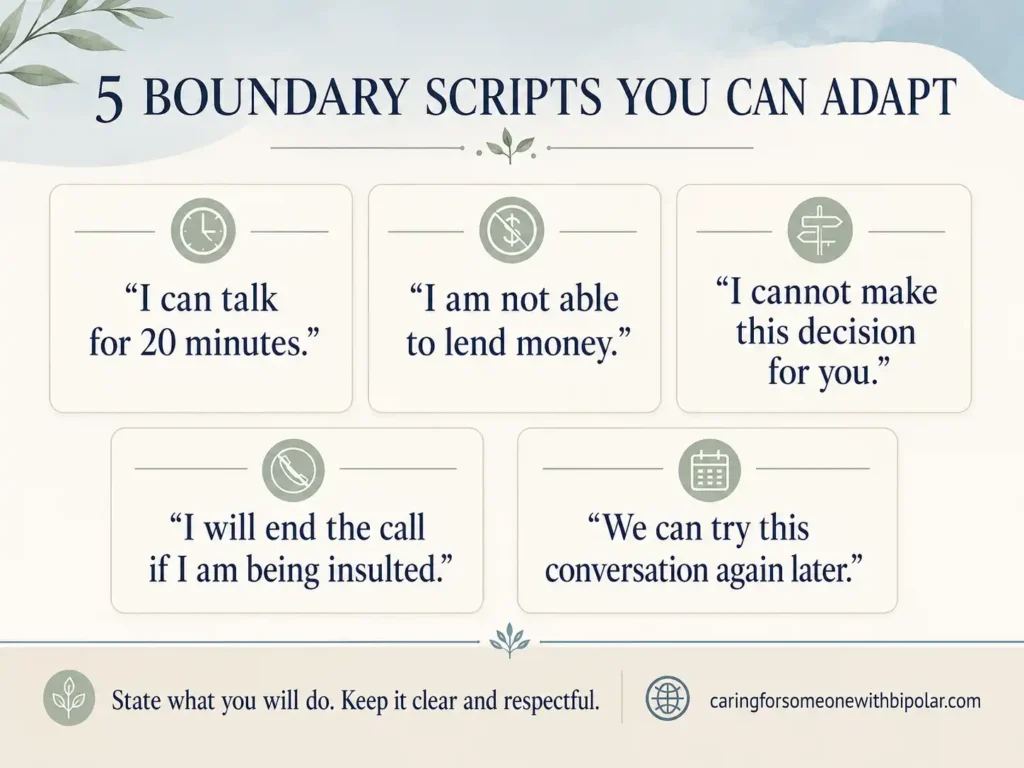
A boundary explains what you will do, what you will participate in, or what you are able to offer. It is different from demanding that another adult think, feel, or behave exactly as you want.
For a broader framework, see setting boundaries with someone who has bipolar disorder.
Decide what the boundary protects
Identify the real purpose of the boundary. It may protect your sleep, time, children, home, finances, privacy, emotional capacity, or physical safety.
A clear purpose makes it easier to choose a limit that you can realistically maintain.
State what you will do
Focus on your own action:
- “I will end the call if I am being insulted.”
- “I am not available for visits without advance notice.”
- “I am not able to lend money.”
- “I will leave if the conversation becomes threatening.”
This is more workable than trying to control your parent’s mood or force agreement.
Keep the message short
A long explanation can turn the boundary into a debate. State the limit clearly, answer necessary questions, and avoid repeatedly defending it.
You can return to the same short statement when the conversation moves away from the actual issue.
Follow through consistently
If you say you will end a call when shouting begins, following through is part of the boundary. You do not need to do this harshly.
You might say, “I am ending the call now. We can try again another time.”
Avoid turning the boundary into a threat or diagnosis
Avoid statements such as “You are manic, so I am not listening to you” or “If you cared about me, you would calm down.” These phrases attack the person or attempt to diagnose the moment.
Keep the focus on the specific interaction and what you will do next. You can find more examples in what to say when setting boundaries.
Boundary scripts you can adapt
- “I can talk for 20 minutes, but I will end the call if I am being insulted.”
- “I can help you find the number, but I cannot make this decision for you.”
- “I am not able to lend money.”
- “I will not discuss this while we are shouting. We can try again later.”
- “If you tell me that you may hurt yourself, I will contact crisis support.”
Use only a script that matches what you are prepared to do. The purpose is not to sound perfect. It is to communicate a limit clearly and respectfully.
How Much Contact Is Healthy or Sustainable?
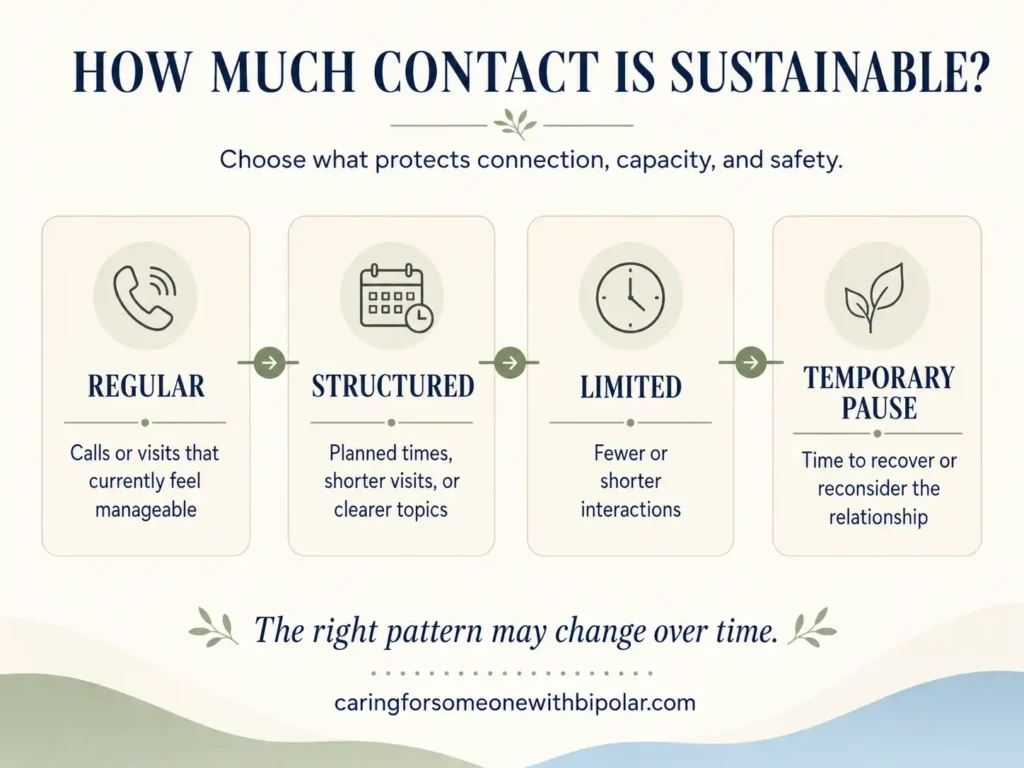
There is no universal amount of contact that is right for every adult child and parent. A sustainable pattern depends on the relationship, current behavior, practical responsibilities, safety, and your emotional capacity.
The level of contact may also change over time. Choosing structured or limited contact now does not necessarily decide the relationship forever.
| Contact Pattern | What It May Look Like | What It May Protect |
|---|---|---|
| Regular contact | Calls, messages, or visits that currently feel manageable | Connection and consistency |
| Scheduled or structured contact | Calls at set times, shorter visits, or planned topics | Time, energy, and predictability |
| Limited contact | Fewer or shorter interactions and clearer reasons for contact | Emotional capacity and personal stability |
| Temporary pause | A defined break while you recover or reconsider the relationship | Space after serious conflict or harmful behavior |
Some people consider a longer separation when there is ongoing serious harm, coercion, or danger. That is a significant personal decision, not a universal recommendation. A qualified mental health professional, advocate, or other trusted source of support may help you examine your circumstances without pressuring you toward reconciliation or separation.
How Can You Stop Feeling Responsible for Your Parent?
Feeling responsible can be especially intense when you fear what may happen if you step back. You might worry that saying no will trigger a crisis, prove that you are selfish, or leave your parent without help.
Those fears deserve attention, but they do not automatically mean that every request is yours to fulfill.
Separate care from control
Care can mean listening, providing information, offering a ride, or helping with a task you have freely chosen. Control means trying to guarantee your parent’s mood, decisions, treatment participation, or future stability.
You can influence a situation. You cannot guarantee its outcome.
Pause before reversing a boundary because of guilt
Discomfort after saying no does not necessarily mean the boundary was wrong. Before changing it, ask what new information has appeared.
If nothing about the actual need or safety situation has changed, the feeling of guilt may need support rather than an immediate reversal of your limit.
Share responsibility where possible
One adult child should not automatically become the entire family response system. When appropriate, consider whether another relative, trusted friend, healthcare professional, peer-support resource, or community service can share part of the responsibility.
Your role may be important without being unlimited.
What If Your Parent Refuses Help?
You can offer information, transportation, a phone number, or help preparing a question for a professional. You should not assume that you can make treatment decisions for another adult or force them to participate in care.
State clearly what you can offer and what you cannot take on. For example:
“I can help you contact the clinic, but I cannot be your only plan if you choose not to call.”
Refusal of help can become especially difficult when safety changes. The dedicated guide on what to do when someone with bipolar disorder refuses help explains this distinction in greater detail.
What Should You Do During Mania or a Crisis?
A difficult call or disagreement is not automatically a mental health crisis. Concerning symptoms are also not the same as immediate danger.
If your parent appears to be experiencing an active manic episode, avoid trying to diagnose, argue away, or personally manage the episode. The guide on how to help someone during a manic episode provides more specific guidance for that stage.
When the situation is calm enough, a shared bipolar emergency plan can clarify contacts, preferences, warning signs, and practical steps before another difficult period occurs.
In the United States, call or text 988 when your parent is in emotional distress, may be thinking about suicide, or when you are worried about a loved one and need crisis support. If there is an immediate, life-threatening emergency, call 911.
Do not promise to keep suicidal thoughts or plans secret. Seek appropriate crisis support instead.
How Can You Process the Past Without Reducing Everything to Bipolar Disorder?
You may have memories of uncertainty, disappointment, conflict, or responsibilities that felt too large for your age. You may also have positive memories that do not fit a simple story of harm.
You do not need to decide that every event was caused by bipolar disorder. Family history can involve symptoms, personality, circumstances, relationship patterns, and choices that are difficult to separate years later.
A more useful set of questions may be:
- What happened?
- How did it affect me?
- What do I need in my adult life now?
- What patterns do I want to continue or change?
- What questions may never have a certain answer?
Individual therapy or peer support can provide space to explore difficult family experiences without requiring you to blame the diagnosis, excuse the impact, forgive immediately, or choose a specific level of contact.
How Can You Communicate When the Relationship Is Calm?
Calmer periods may provide a better opportunity to discuss expectations, practical support, and boundaries. These conversations cannot guarantee agreement, but they can reduce uncertainty about what you are willing to do.
For more general communication guidance, read how to communicate with someone who has bipolar disorder.
Address one issue at a time
Choose a specific concern rather than reopening the entire history of the relationship. A focused conversation is easier to understand and less likely to become a list of unrelated grievances.
Describe impact instead of diagnosing intent
Say what happened and how it affected you:
“When the conversation turns into shouting, I end the call because I cannot continue productively.”
This is clearer than guessing whether your parent intended to upset you or whether a diagnosis caused the behavior.
Ask what support is wanted
You can ask:
“What kind of help would be useful, and what would you prefer to manage yourself?”
This allows your parent to express preferences and helps you avoid automatically taking over.
Discuss limits before another difficult period
When possible, talk about call length, visits, money requests, transportation, emergency contacts, and what will happen if a conversation becomes unsafe or unmanageable.
Written notes or a shared support plan may reduce confusion later, but they do not replace professional care.
Accept that agreement may not be possible
Your parent may disagree with a boundary. Agreement is not required for you to decide what you will do with your own time, home, money, and participation.
You can remain respectful without debating the limit indefinitely.
How Do You Protect Your Time, Home, and Finances?
Protecting your adult life is legitimate whether or not you identify as a caregiver. It can include deciding when visits are welcome, how long someone may stay, which conversations can happen in your home, and what financial help you are willing to consider.
Give yourself time before:
- Lending money
- Co-signing a loan or agreement
- Sharing an account
- Offering long-term housing
- Taking responsibility for ongoing bills
- Making a commitment during an emotionally intense conversation
You can say, “I need time to review this before I answer.”
If an issue has significant financial, housing, contractual, or legal consequences, seek advice from an appropriately qualified professional. This article cannot determine the right financial or legal decision for your circumstances.
Adult Children Need Support Too
Your needs can disappear from view when the relationship becomes organized around your parent’s health, requests, or crises. You may need support even when you are not providing daily care.
Possible sources of support include:
- A qualified therapist or counselor
- A trusted partner, friend, or family member
- A family or caregiver peer-support group
- A local NAMI affiliate
- A DBSA friends and family group
- Time and activities that have nothing to do with caregiving
Support can help you examine guilt, anger, grief, or uncertainty without making your parent the focus of every part of your life.
When the role has become exhausting or difficult to sustain, the guide on bipolar caregiver burnout can help you identify the pressure you are carrying.
A Boundary and Responsibility Checklist
This checklist is an organizational tool, not clinical, legal, or financial guidance.
- Am I responding to a real need or mainly to guilt?
- Is this help freely chosen?
- Is this request safe for my home, finances, time, and wellbeing?
- Am I trying to control something I cannot control?
- Have I stated my limit clearly?
- Can someone else share this responsibility?
- Is this a difficult interaction, a mental health crisis, or immediate danger?
- What support will I need afterward?
Trusted Resources
- National Institute of Mental Health: Bipolar Disorder
- NAMI: Maintaining a Healthy Relationship
- DBSA: For Friends and Family
- 988 Suicide & Crisis Lifeline: Help Someone Else
Frequently Asked Questions
Is it normal to feel angry with a parent who has bipolar disorder?
Anger can be an understandable response to hurt, uncertainty, repeated pressure, or unmet needs. It can exist alongside love, concern, loyalty, or grief. Feeling angry does not automatically mean that you are uncaring. What matters is how you respond to the feeling and whether you have a safe place to process it.
Am I responsible for helping my parent?
You can choose to offer help, but you are not solely responsible for managing your parent’s condition, treatment decisions, finances, crises, or recovery. Decide what support you can freely and sustainably provide, and involve appropriate professionals or other resources when the situation exceeds your role.
How do I set boundaries without abandoning my parent?
Focus the boundary on your own actions. You might limit the length of a call, decline a financial request, require advance notice before a visit, or end a conversation when you are being insulted. A boundary does not require you to reject your parent as a person.
Is it acceptable to limit contact with a parent who has bipolar disorder?
Some adult children choose structured, limited, or temporarily paused contact when ordinary contact is not sustainable. The appropriate level depends on the relationship, safety, current behavior, and your capacity. Limiting contact should not be presented as a universal solution or punishment for having bipolar disorder.
What should I do if my parent is manic or in crisis?
Respond to the actual situation rather than relying on the diagnosis alone. Encourage appropriate professional support when symptoms are concerning. In the United States, call or text 988 when your parent is in emotional distress or when you need crisis guidance about a loved one. Call 911 in an immediate, life-threatening emergency.
Final Takeaway
You can care about your parent without making their illness the center of your entire adult life. Compassion can coexist with limits. Love can coexist with anger or grief. Support can be meaningful without becoming permanent responsibility for another adult’s moods, treatment, choices, or crises.
The goal is not to find one perfect boundary or one universally correct level of contact. It is to build a role that respects your parent’s dignity while also protecting your time, safety, relationships, finances, and emotional wellbeing.