Setting Boundaries with a Bipolar Loved One: A Caregiver’s 10-Step Framework

Why “Love Is Enough” Was the Lie I Believed
When my partner was diagnosed with bipolar disorder three years ago, I thought love would be enough. I thought that if I just stayed patient, stayed calm, and stayed present, the storm would pass and we would find our way back to each other. I was wrong.
Within six months, I was sleeping with my phone under my pillow, waiting for the 3 AM text that meant another manic episode was starting. I was canceling plans because I didn’t know which version of him would show up. I was explaining away $800 guitar purchases to our landlord. And I was slowly disappearing.
Setting boundaries with a bipolar loved one is not about punishment. It is about preservation — yours, theirs, and the relationship’s.
This is the 10-step framework I built, piece by piece, after three years of being a caregiver. It is not clinical theory. It is what I actually did. Some steps I learned from therapists. Others I learned at 2 AM, crying in my car. All of them work — if you are willing to hold them with both compassion and conviction.
If you are reading this at midnight, exhausted and unsure of what tomorrow looks like, I wrote this for you.
Quick Answer
What is the best way to set boundaries with a bipolar loved one?
Set boundaries during stable periods, not during an episode. Write down 5 non-negotiables. Create a crisis contract together. Use pre-written scripts for high-stress moments. Implement financial safeguards like spending thresholds and separate accounts. Protect your sleep with a fixed bedtime. Build a support system outside the relationship. Get your own therapist. Boundaries are not punishment — they are the conditions of your sustainable participation in the relationship.
At a Glance: The 10-Step Framework
| Step | What It Covers | Time to Implement |
|---|---|---|
| 1. Boundary vs. Wall | Learn the difference between protective limits and emotional shutdown | 10 min |
| 2. Non-Negotiables | Write 5 boundaries while your partner is stable | 20 min |
| 3. Crisis Contract | Written agreement for warning signs, actions, and hard lines | 30 min |
| 4. Scripts | Pre-written phrases for common high-stress situations | 15 min |
| 5. Financial Boundaries | Separate accounts, spending thresholds, credit holds | 1 hour |
| 6. Sleep Boundary | Fixed bedtime regardless of household crises | Immediate |
| 7. Pause Button | Delay tactic for manic conversations | Practice |
| 8. Support System | 3 people: weekly check-in, therapist, emergency contact | 1 week |
| 9. Consequences | Natural results for crossed boundaries, not punishments | Ongoing |
| 10. Caregiver Therapy | Individual therapy for the caregiver | 1-2 weeks to find |
Total setup time: 2-4 hours spread over one week Maintenance: 15 min/week review + quarterly crisis contract update
Step 1: Understand the Difference Between a Boundary and a Wall
The first mistake I made was confusing boundaries with emotional walls. A wall says: “I am done with you.” A boundary says: “I love you, and this is how I can stay in this relationship without losing myself.”
According to Johns Hopkins Medicine, maintaining healthy communication and setting clear expectations are essential when one partner has bipolar disorder. But what the medical articles don’t always explain is the emotional weight of holding that line when someone you love is screaming that you are abandoning them.
What I actually did:
In my first year, I would set a boundary — “I need you to tell me before you spend more than $100” — and then crumble the moment he looked hurt. I thought holding the boundary made me cold. It took a therapist to reframe it: “Every time you collapse a boundary, you teach both of you that your needs are negotiable.”
A boundary is not a negotiation. It is a condition of your participation.
Practical distinction:
- Wall: “If you have another episode, I’m leaving.” (Threat, all-or-nothing)
- Boundary: “If you stop taking your medication, I will not manage the consequences alone. I will call your psychiatrist and step back until you are stable.” (Action-based, protective, preserves relationship)
Step 2: Identify Your Non-Negotiables Before the Next Episode
You cannot build boundaries in the middle of a hurricane. When my partner was manic, my ability to think clearly dropped by 60%. When he was depressed, my guilt made me say yes to things I would never normally agree to.
Your non-negotiables must be written down when everyone is stable.
My non-negotiables (as an example):
- I will not lend money during an untreated episode.
- I will not stay awake past midnight trying to “talk him down” from mania.
- I will not lie to family, friends, or employers to cover for symptoms.
- I will not cancel my own therapy appointments to manage a crisis.
- I will not tolerate verbal abuse — even if it is “the illness talking.”
Exercise for you: Take 20 minutes this week. Write five non-negotiables. Do not show them to your partner yet. Let them sit for 48 hours. Edit them. Make sure they are about your behavior and limits, not about controlling your partner’s illness. Boundaries are about what you will do. They are not rules you enforce on another adult.
Step 3: Create a “Crisis Contract” Together in a Stable Period
A crisis contract is an agreement written when your partner is stable, detailing what each of you will do when symptoms escalate. It is one of the most powerful tools a caregiver can have — and one of the hardest to implement.
What the research says:
Crisis planning is a cornerstone of bipolar management. The Depression and Bipolar Support Alliance (DBSA) recommends that caregivers and loved ones develop written agreements that include early warning signs, preferred interventions, and contact information for treatment providers. This is not just good practice — it is protective for both parties.
What I actually did:
Our crisis contract includes:
- Early warning signs I agree to watch for: decreased sleep, pressured speech, increased spending, social media over-posting.
- Actions my partner agrees to: contact psychiatrist within 24 hours of my expressing concern; allow me to hold credit cards during elevated mood; take prescribed PRN medication if agreed in advance.
- Actions I agree to: not argue about delusional ideas; not engage in financial discussions after 8 PM; contact his sister if I am unsafe.
- Hard lines: if he becomes verbally abusive, I leave the apartment and stay with a friend. If he becomes physically unsafe, I call 911.
Important: This contract is not a legal document. It is a relational agreement. Review it every three months. Adjust it. And accept that in a severe episode, your partner may not remember it. That is why your boundaries (Step 2) must be independent of their cooperation.
Step 4: Use Scripts, Not Improvisation
When someone you love is manic, your brain enters survival mode. You do not have the cognitive bandwidth to craft thoughtful responses. That is why you need scripts — word-for-word phrases you have practiced and can deploy without thinking.
Scripts that worked for me:
| Situation | Script |
|---|---|
| Partner wants to make a large purchase during mania | “I hear that this feels urgent to you. Our agreement is that we talk about purchases over $100 together. I am not saying no forever. I am saying we need to revisit this when you have slept more than four hours.” |
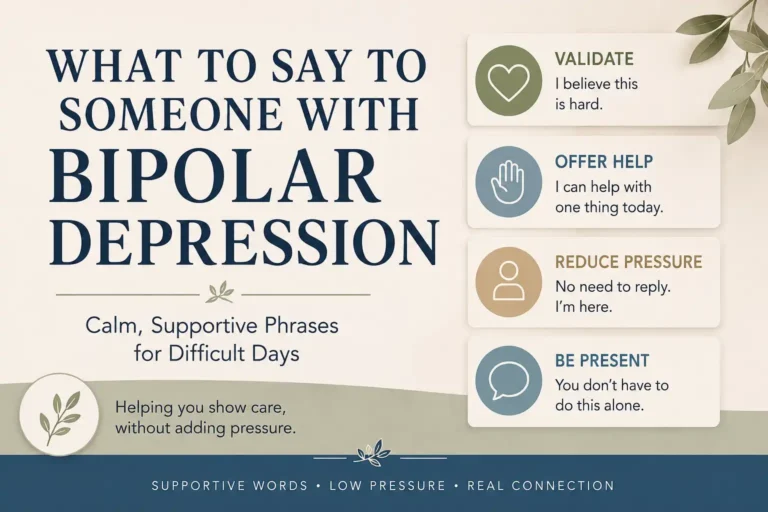
| Partner accuses you of not loving them during depression | “I love you, and I am not leaving. I also know that depression is telling you I am distant. I am going to give you space right now because that is what helps me show up fully later.” |
| Partner is yelling during an episode | “I am not going to stay in this conversation while voices are raised. I will be in the bedroom. When you are ready to talk without yelling, I am ready to listen.” |
| Partner asks you to skip work to care for them | “I cannot skip work today. I have arranged for [sister/friend/crisis line] to check in at noon. I will call you at 6 PM.” |
Why scripts work:
Scripts remove the emotional improvisation that leads to guilt, escalation, or collapse. They give you language when you have none left. I keep mine written in the Notes app on my phone. I read them verbatim when I need to.
Step 5: Set Financial Boundaries That Protect Both of You
Financial harm is one of the most common and destructive consequences of untreated bipolar mania. According to the International Bipolar Foundation, impulsive spending during manic episodes can destroy credit, drain savings, and create legal liability for spouses in shared-account states.
What I actually did:
After my partner spent $3,200 on musical instruments in ten days during a manic episode, we made structural changes — not just promises.
Our financial boundary system:
- Separate accounts: We maintain one joint account for fixed bills only. Everything else is separate.
- Spending threshold: Any purchase over $100 requires a 24-hour waiting period and verbal confirmation from both of us.
- Credit freeze: During stable periods, we agree that I will hold his credit cards if warning signs appear. He can request them back after 48 hours of stable sleep.
- Transparency apps: We use a shared budgeting app (YNAB) where both of us can see transactions in real time. This is not surveillance. It is shared accountability.
Affiliate Note: If you are struggling to rebuild your finances after bipolar-related overspending, structured budgeting tools can help restore a sense of control. See our recommended resources for caregivers →
The boundary is not “you cannot spend money.” The boundary is: “I will not be financially responsible for decisions made during an untreated episode, and I will protect our shared future by creating structural safeguards.”
Step 6: Protect Your Sleep — It Is a Boundary, Not a Luxury
Sleep deprivation is the silent killer of caregiver health. It is also the fastest way to collapse every other boundary you have built. When I was sleeping four hours a night, I said yes to things I would never normally agree to. I cried at work. I stopped eating regularly.
What the research says:
Sleep disruption in caregivers is associated with depression, anxiety, and reduced immune function. The Journal of Clinical Sleep Medicine has documented that caregivers of individuals with mood disorders experience sleep fragmentation at rates comparable to parents of newborn infants — but without the social support or the expectation that the phase will end.
What I actually did:
I instituted a “sleep boundary” that felt brutal at first and saved my life within a month.
My sleep boundary:
- I go to bed at 10:30 PM regardless of what is happening in the household.
- If my partner is manic and wants to talk, I say: “I love you, and I need to sleep so I can be helpful tomorrow. I will not be helpful if I am awake all night.”
- If he is unsafe, I call his sister or a crisis line — I do not stay awake managing the situation alone.
- I do not check my phone after 10 PM except for emergency contacts.
This boundary was the hardest to hold because it felt like abandonment. It is not. It is survival. You cannot care for someone if you are hallucinating from exhaustion.
Step 7: Learn the “Pause Button” Technique for Manic Conversations
Manic conversations have a specific texture: fast, associative, grandiose, and impossible to interrupt without triggering rage or hurt. Early in our relationship, I tried to reason with my partner during these conversations. I lost every time.
The Pause Button Technique:
Instead of engaging with the content of a manic idea, you engage with the process.
Script:
“I can tell this idea is really important to you right now. I am having trouble keeping up with the details because my brain is tired. Can we write this down and revisit it tomorrow at 10 AM? I want to give it my full attention, and I can’t do that right now.”
Why this works:
- It validates the emotion without validating the delusion or impulsive plan.
- It introduces a time delay, which is often enough for the manic urgency to decrease.
- It gives you an exit that does not feel like rejection to your partner.
- It protects you from being drawn into 90-minute circular conversations at midnight.
What I actually did:
I bought a small whiteboard and put it in the kitchen. During manic periods, when my partner had an “urgent” idea, I would say: “Write it on the board. We will look at it together tomorrow.” About 60% of the time, by tomorrow, the urgency had passed. The other 40% became genuine conversations we could have while stable.
Step 8: Build a Support System Outside the Relationship
The most dangerous place for a caregiver is isolation. When you are the only person who knows what is happening, the relationship becomes your entire world. That is how boundaries dissolve — because enforcing a boundary feels like destabilizing your entire universe.
What I actually did:
I told three people: my sister, my best friend, and my therapist. I gave them a simple brief: “I am caring for someone with bipolar disorder. I may need to talk without needing solutions. I may need someone to remind me of my boundaries when I am too tired to remember them.”
Your support system should include:
- One person who checks in weekly: Not someone you call only in crisis. Someone who texts every Tuesday.
- A therapist for YOU: Not couples therapy. Individual therapy for the caregiver. This is non-negotiable.
- A peer support group: NAMI Family Support Groups and DBSA have online and in-person meetings specifically for caregivers. Hearing someone else say, “I also felt guilty for sleeping” is medicine.
- An emergency contact: Someone who can come over in 20 minutes if you need to leave the house.
Affiliate Note: If you do not have a therapist yet, online therapy platforms make it possible to get support without leaving home — critical when your schedule is unpredictable. I started with BetterHelp six months into caregiving, and it gave me the language and the boundaries I didn’t know I needed. Start with 20% off your first month →
Step 9: Know When to Enforce Consequences (And What They Should Be)
Boundaries without consequences are just suggestions. This was the hardest lesson for me. I thought that if I loved someone enough, they would respect my boundaries out of gratitude. Bipolar disorder does not work that way. Mania impairs judgment. Depression impairs motivation. Your boundary must have a consequence that you can execute independently.
Consequences are not punishments. They are the natural result of a boundary being crossed.
My boundary-consequence pairs:
| Boundary | Consequence |
|---|---|
| I will not lend money during an untreated episode. | If money is borrowed without discussion, I will not cover the shortfall. I will let the natural financial consequence happen. |
| I will not tolerate verbal abuse. | If yelling or name-calling occurs, I leave the room. If it continues, I leave the house for 24 hours. |
| I will not cancel my therapy appointments for a crisis. | If a crisis happens during my appointment, I call the crisis line or his sister. I do not reschedule my appointment. |
| I will not manage medication compliance alone. | If he stops taking medication, I notify his psychiatrist and step back from managing daily life logistics. |
What I actually did:
The first time I enforced a consequence — leaving the house after an hour of verbal abuse — I cried in my car for 45 minutes. I felt like a monster. But the next morning, he was stable enough to apologize. And more importantly, he knew I meant what I said. The frequency of escalation dropped significantly after that.
Step 10: Get Support for the Caregiver — Because You Cannot Pour From an Empty Cup
This is the step I resisted the longest. I thought therapy was for people with “real” problems. My problem was just “being a good partner.” It took a panic attack at my desk job to realize that caregiving had become my identity, and that identity was eating me alive.
What the research says:
Caregivers of individuals with bipolar disorder experience rates of depression and anxiety that are significantly higher than the general population. A 2020 study in the Journal of Affective Disorders found that caregiver burden in bipolar disorder was correlated with worse patient outcomes — meaning your mental health directly affects their stability.
What I actually did:
I started therapy through an online platform because I could not predict when I would have 90 minutes to drive to an office, park, and cry in a waiting room. I needed flexibility. I needed someone who understood that my schedule was hostage to someone else’s brain chemistry.
My therapist did not try to fix my partner. She helped me answer questions I was too ashamed to ask out loud:
- Is it okay to want to leave sometimes?
- Am I making his illness worse by setting boundaries?
- How do I know if I am a caregiver or just a doormat?
- What does a healthy relationship with someone bipolar actually look like?
Affiliate Note: Caregiver therapy is not a luxury. It is maintenance. If you are holding boundaries, managing crises, and trying to keep a household functional, you need a space where the focus is entirely on you. Find a therapist who understands caregiver burnout →
I also recommend two books that changed my framework:
- Loving Someone with Bipolar Disorder by Julie A. Fast and John Preston — practical, non-judgmental, written for partners.
- Boundaries by Henry Cloud and John Townsend — not specific to mental illness, but essential for anyone who confuses love with self-abandonment.
Affiliate Note: See our full list of recommended books and tools for bipolar caregivers →
What a Healthy Boundary Looks Like in Real Life
Here is what our life looks like now, three years in:
Last month, my partner started showing early warning signs — decreased sleep, irritability, a sudden interest in starting a business. I noticed on a Tuesday. On Wednesday, I said: “I am seeing the signs we agreed on. I need you to call your psychiatrist today.” He resisted. I held the boundary: “I love you, and I am not managing this week alone. If you do not call by 5 PM, I will call.”
He called. The psychiatrist adjusted his medication. The episode never fully developed. We did not have a crisis. We had a maintenance event.
That is what boundaries make possible. Not perfection. Not the absence of illness. But the absence of catastrophe.
Frequently Asked Questions
Yes — during stable periods. During manic or severe depressive episodes, judgment is impaired, which is why boundaries must be structural (financial controls, crisis contracts) rather than purely relational. Respect for boundaries often improves as treatment stabilizes and trust is rebuilt through consistent caregiving.
Yes. Leaving temporarily to protect your safety, sleep, or mental health is not abandonment. It is a boundary. Many caregivers find that temporary separation — whether for a night, a weekend, or a structured break — actually preserves the long-term relationship by preventing caregiver burnout and resentment.
Guilt is the most common emotional barrier for caregivers. The reframe that helped me: boundaries are not something you do to your partner. They are something you do for the relationship. Every boundary you hold is a message that the relationship is worth preserving — and that preservation requires both people to be safe.
Financial boundaries include: separate accounts for discretionary spending, spending thresholds requiring 24-hour delays, credit card holds during warning sign periods, and agreements that the caregiver will not cover debts incurred during untreated episodes. These should be written and reviewed during stable periods.
Absolutely. Caregiver therapy is associated with reduced depression, better relationship outcomes, and improved patient stability. Individual therapy for the caregiver — not just couples therapy — provides space to process guilt, establish boundaries, and maintain identity outside the caregiving role.

Final Thoughts: You Are Allowed to Need This
If you take nothing else from this article, take this: you are allowed to need boundaries. You are allowed to need sleep, money, safety, therapy, and a life that is not entirely consumed by someone else’s illness. Needing these things does not make you a bad partner. It makes you a sustainable one.
I am Elena. I am still a caregiver. I am still learning. But I am no longer disappearing. And neither should you.
If this framework helped you, please share it with another caregiver who needs it. And if you are ready to build your own support system, start here →
Related Articles:
- How I (Elena) Learned to Say No Without Guilt: A Caregiver’s Story
- What to Say During a Manic Episode: 7 Scripts That Work
- Caregiver Burnout: The Warning Signs I Ignored
- My Story as Elena: Caring for Someone with Bipolar
Published: June 2026 | Author: Elena | Reviewed for accuracy: Caregiver experience framework, citations from Johns Hopkins Medicine and DBSA.