
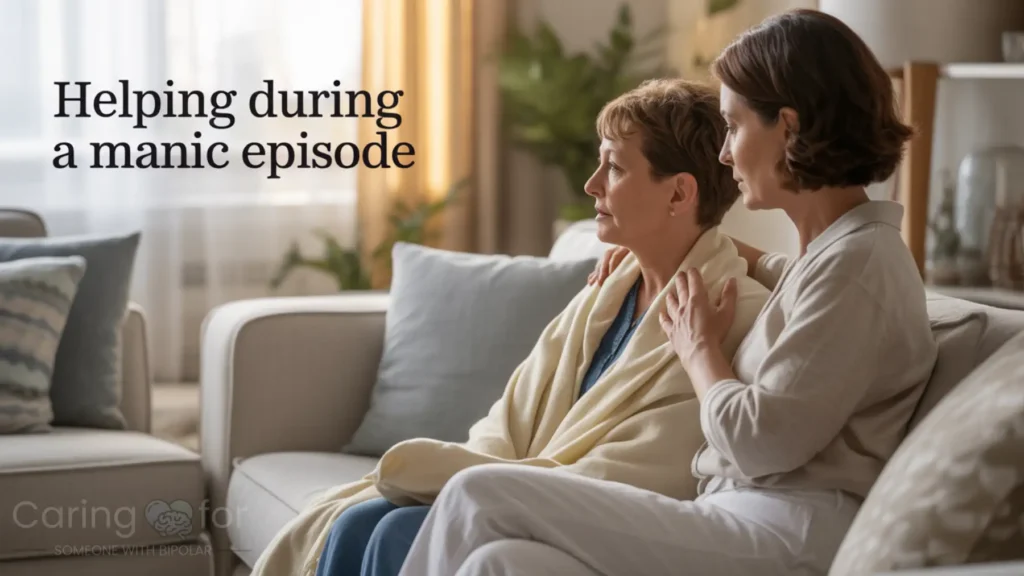
If you’re searching this right now, things may feel urgent, confusing, and scary. Maybe the person you love has not slept, is talking very fast, is making risky choices, or seems hard to reach. As a caregiver who has lived through bipolar crises with a loved one, I wrote this guide to share the steps that help most in the moment.
This is not about finding perfect words. It is about lowering risk, keeping connection, and knowing when to bring in outside help.
Emergency Contacts (U.S.)
- Immediate physical danger: Call 911
- Urgent crisis support & guidance: Call or text 988
If talking already feels tense, this guide on communication with someone who has bipolar can help you keep your words calm and simple.
Quick help checklist (60 seconds)
- Stay calm and quiet: Keep your voice low. Use short sentences. Do not argue or try to win with logic.
- Lower stimulation: Dim lights, lower noise, pause screens, and move to a quieter room if you can.
- Delay risky choices: Put off driving, spending, travel, quitting a job, or major decisions until tomorrow.
- Bring in backup: Contact their clinician, a trusted family member, or the person listed in your bipolar emergency plan.
- Get urgent help: Call or text 988 for crisis help, or call 911 if there is immediate danger.
What mania can look like
A manic episode is more than just being in a very good mood. It can bring a big change in energy, judgment, sleep, and behavior. Some people seem excited and driven at first. Others become irritable, restless, or angry. In more severe cases, a person may lose touch with what is real.
Common signs include:
- Very little sleep without feeling tired
- Fast speech or jumping from one idea to another
- Racing thoughts
- Big plans that do not match reality
- Risky spending, risky driving, risky sex, or sudden travel plans
- Feeling unusually powerful, gifted, or unstoppable
- Irritability that turns into arguments very fast
- Delusions or hearing or seeing things that are not there
Hypomania can look similar, but it is usually less severe. Mania causes more harm, more loss of control, and more danger. Learning to spot the early signs of bipolar disorder can help you act before the crisis peaks.
What to do in the next 10 minutes
When mania is building, your first job is not to prove a point. Your first job is to make the moment safer.
- Slow yourself down first.
Take one breath before you speak. Your tone matters as much as your words. - Lower the noise.
Turn off the TV. Pause music. Ask extra people to step out. Too much noise can make things worse fast. - Use short sentences.
Long talks often add fuel. Say one thing at a time. - Offer a safer next step.
Try, “Let’s sit down for a minute,” or “Let’s get some water first.” - Delay big decisions.
Use time as your friend. Try, “We do not need to decide that tonight.” - Offer food and water.
It may be hard for them to sit through a full meal, so simple foods like sandwiches, yogurt, crackers, cheese, fruit, or protein bars may work better.
Why arguing usually backfires
During mania, the brain is not working from the same place it does when the person is well. Judgment may be off. Insight may be low. Risk may not feel real to them. That is why facts alone often do not calm the situation.
Try shifting your goal from “I need to make them see this” to “I need to keep this calm and safe.” That shift can change the whole tone of the moment.
Use these simple swaps:
- Instead of “That makes no sense,” say “I can see this feels very real to you.”
- Instead of “You are wrong,” say “I hear you. I want to help keep things safe.”
- Instead of “Stop this now,” say “Let’s slow this down for a minute.”
What to say
Calm tone and simple words usually work better than long talks. Choices can also lower power struggles, so give two safe options when you can.
Try lines like these:
- “I care about you. I’m here with you.”
- “You do not have to figure this out right now.”
- “Would you rather sit here with me or go to a quieter room?”
- “Let’s wait until tomorrow before any big decision.”
- “I’m not trying to control you. I’m trying to help keep this safe.”
- “Let’s do one small thing first. Water, food, or a quiet room.”
For more scripts that help in tense moments, read communication with someone who has bipolar.
What not to say
Shame, sarcasm, and commands often make mania worse. Even when you are worn out, try not to add more heat to the moment.
Avoid lines like:
- “You are crazy.”
- “Calm down.”
- “You are embarrassing me.”
- “You are doing this for attention.”
- “If you loved me, you would stop.”
- “You always do this.”
For more phrases to avoid, see what not to say to someone with bipolar.
How to lower risk without a fight
When things are building, act earlier than you think you need to. It is easier to guide the moment while you still have some cooperation.
Try these steps:
- Move to a quieter room.
- Keep your body language loose and non-threatening.
- Do not crowd them or block the exit.
- Put space between them and car keys, alcohol, weapons, or large amounts of money if you can do so safely.
- Delay online shopping, travel booking, quitting jobs, posting on social media, or texting people in anger.
- Ask one trusted person to join you so you are not handling it alone.
In partner or family situations, it helps when each person has a role. One person can stay present and calm. Another can handle calls, logistics, and childcare.
Signs mania is getting worse
Watch for change over hours or days, not just one hard talk.
- No sleep for one or more nights
- Rapid speech that does not slow down
- More anger, more pacing, more impulsive choices
- Rising paranoia
- Beliefs that are clearly false but feel fixed to them
- Hearing voices or seeing things that are not there
- Refusing all help while risk keeps rising
If spending, unsafe driving, or major life choices keep showing up during episodes, this guide on untreated bipolar disorder gives more context on why repeated episodes can raise risk over time.
When to call 988 or 911
Use a simple rule: get help sooner when safety, reality testing, or basic care starts to break down.
Call or text 988 if:
- You need crisis guidance right now
- The person is escalating and you do not know what step to take next
- They are in deep distress and need urgent mental health help
- You need help deciding whether this has become an emergency
Call 911 if:
- There is immediate danger to them or someone else
- They are trying to drive while clearly unsafe
- They are violent or threatening violence
- They are so disoriented that you cannot keep the setting safe
- They are running into traffic, trying to leave in a dangerous state, or cannot care for basic needs
What to do if psychosis is present
Some manic episodes include psychosis. That can mean delusions, hallucinations, or a strong break from reality.
When that happens:
- Do not argue about whether the belief is true.
- Do not mock it or try to trap them with logic.
- Validate the feeling without agreeing with the false belief.
Try lines like:
- “That sounds frightening.”
- “I can see this feels very real to you.”
- “You are safe with me right now.”
- “Let’s sit down and take this one step at a time.”
If psychosis is present and safety is slipping, move to urgent help fast.
If they refuse help
Refusal is common during mania. The person may feel powerful, clear-minded, and sure that nothing is wrong. In that moment, your goal is harm reduction, not total agreement.
What helps most:
- Offer choices, not orders: “Would you rather call tonight or tomorrow morning?”
- Ask for one small safety step: “Can we agree not to drive tonight?”
- Use time to slow things down: “Let’s wait one hour, then decide.”
- Write down what you are seeing so you can report it clearly later.
If the refusal is paired with growing danger, loss of reality, or no sleep for days, do not wait too long to bring in outside help.
How to involve treatment
If the person has a psychiatrist, therapist, or primary care doctor, contact them early. You may not be able to get full details back, but you can still share what you are seeing.
Keep it simple and concrete:
- How much sleep they have had
- Whether they are eating
- Any risky spending or unsafe behavior
- Any threats, delusions, or hallucinations
- How fast things have changed
If medication or diagnosis questions are coming up, these guides may help:
After the episode
When symptoms ease, many people feel shame, confusion, grief, or anger about what happened. Try to keep the first talk gentle and short.
A good order is:
- Start with care: “I’m glad you are safer now.”
- Name the strain without blame: “That was very hard on both of us.”
- Ask permission: “Can we talk about what helped and what made it worse?”
- Pick one next step: “Let’s write down what we will do sooner next time.”
This is the best time to update your bipolar emergency plan.
If they said cruel or cutting things during the episode, try not to treat every word as a full picture of what they truly feel. Mania can change judgment, impulse control, and the way someone speaks. That does not erase the hurt, but it can help you place the words in context.
Protecting yourself
Supporting someone through mania can drain your sleep, your focus, your money, and your sense of safety. You need a plan too.
Small steps that help:
- Sleep when another safe adult can cover for you
- Eat and drink even when the day feels chaotic
- Write down what is happening instead of trying to hold it all in your head
- Call one person who can stay with you in this, even just by phone
- Set limits and keep them steady
Examples of healthy limits:
- “I will not stay in a room where I am being screamed at.”
- “I will not hand over money during an episode.”
- “If there are threats of self-harm or violence, I will call for emergency help.”
For more help with this part, read setting boundaries with someone with bipolar disorder.
Partner and family guidance
If the person is your spouse or partner, the home can feel unstable very fast. Try to protect routine where you can. Keep children out of adult conflict. Ask one other adult to step in with meals, transport, or childcare.
These guides may help in family settings:
FAQ
Avoid shame, sarcasm, threats, and harsh commands. Calm, short, non-blaming language usually works better.
Use a steady tone, short sentences, and simple choices. Focus on safety and slowing things down, not on winning the argument.
It becomes an emergency when there is immediate danger, severe confusion, psychosis, or the person cannot be redirected away from unsafe behavior. In the U.S., call or text 988 for crisis help and call 911 for immediate danger.
It can last for days or much longer. Do not wait for it to pass on its own if risk is rising. Act early and use clear safety thresholds.
Printable mini-plan
Copy this into your notes app or print it out.
Bipolar Mania: Caregiver’s Quick Response Plan
A practical, 60-second checklist to protect safety, reduce escalation, and keep connection.
When a manic episode escalates, it is hard to think clearly. Use this pre-filled guide to remember what to do, what to say, and who to call. Do not argue with the illness. Focus on safety.
⚠️ 1. My Loved One’s Warning Signs
Check the boxes that fit your situation, or add your own.
- Little to no sleep without feeling tired
- Rapid speech, racing thoughts, or extreme distraction
- Unrealistic plans, grandiose ideas, or delusions
- Impulsive behavior, such as risky spending, unsafe driving, or hypersexuality
- Sudden irritability or escalating anger
- Other:
✅ 2. What I WILL Do Right Now
- Lower stimulation: I will dim the lights, turn off screens or music, and suggest moving to a quieter room.
- Pace my communication: I will keep my voice soft, my body language relaxed, and my sentences short and clear.
- Delay high-risk choices: I will not force them to stop, but I will use time as an ally. For example: “Let’s wait an hour before we buy this,” or “Let’s decide on this trip tomorrow.”
- Offer practical grounding: I will offer water or easy-to-eat finger foods, such as a sandwich, yogurt, crackers, or apple slices, because sitting down for a full meal may be too hard right now.
🛑 3. What I Will NOT Do
- I will not argue about facts: I will not try to use logic to disprove a delusion or an unrealistic idea. Confrontation adds fuel.
- I will not use shaming words: I will avoid saying “Calm down,” “You are acting crazy,” or “You are embarrassing me.”
- I will not block their physical space: I will give them room to move and I will not stand between them and the door.
- I will not handle this alone: If I feel overwhelmed or unsafe, I will call for backup right away.
📞 4. Emergency Contacts
Fill this out today, not during the crisis.
- Trusted Backup Person: Phone:
- Psychiatrist / Therapist: Phone:
- Urgent Crisis Support (U.S.): Call or Text 988 (available 24/7)
- Immediate Physical Danger: Call 911
For a fuller version, use your bipolar emergency plan.
Related reading
- Communication with Someone Who Has Bipolar
- What Not to Say to Someone With Bipolar
- Setting Boundaries With Someone With Bipolar Disorder
- Untreated Bipolar Disorder
- Bipolar Disorder Medication
Medical disclaimer
This article is for educational purposes only and does not replace medical advice, diagnosis, or treatment. If you think someone is in immediate danger, call 911. In the U.S., call or text 988 for urgent mental health crisis support and guidance.